Small Living Room Rug Ideas: Size, Placement & Style
You’ve probably stood in your living room, looked at the floor, and thought — will a rug actually help here, or will it just make everything feel more crowded? That doubt is completely normal. A lot of apartment dwellers go through the exact same thing every time they scroll through home decor content and see stunning rugs in rooms that are clearly twice the size of their own.
But here’s the thing: a rug might be the single most useful tool in your small living room. When you get it right, it creates definition, adds warmth, and tricks the eye into seeing more space than there actually is. When you get it wrong — wrong size, awkward placement, too much pattern — the room can end up feeling cluttered and confused. The good news? The difference between those two outcomes usually comes down to just three decisions: size, placement, and style.
In this guide, you’ll learn how to choose a rug that actually works in a compact space. We’ll cover everything from measuring your floor to picking patterns that don’t overwhelm — plus a few common mistakes that are easy to avoid once you know what to look for. Let’s dig in.
Quick Summary
WHO THIS IS FOR
Apartment renters, first-time homeowners, and small-space dwellers
TIME TO READ
5 min
TOP 3 TAKAWAYS
1. Rug Size Guide for Small Rooms
One of the most common rug mistakes in small living rooms isn’t going too big — it’s going too small. A little rug floating in the middle of the floor actually makes the room feel more cramped, not less. It draws attention to how little space there is rather than unifying the room. Your goal is to find a size that grounds the furniture and gives the space a sense of structure.
For most small living rooms, a 5×8 ft rug is a solid starting point. If you have a longer sofa or a slightly larger footprint, consider stepping up to a 6×9 ft. The rule most interior designers follow is simple: the front legs of your sofa and any accent chairs should sit on the rug, even if the back legs don’t. That connection between furniture and rug is what makes the seating area feel cohesive.
If you’re working with a genuinely tiny space — a studio apartment, for instance — a 4×6 ft rug placed under the coffee table with just the sofa’s front legs touching it can work really well. Always measure before you shop. A great trick: lay painter’s tape on the floor in the exact dimensions of the rug you’re considering. Leave it for a day. You’ll know immediately whether the proportions feel right.
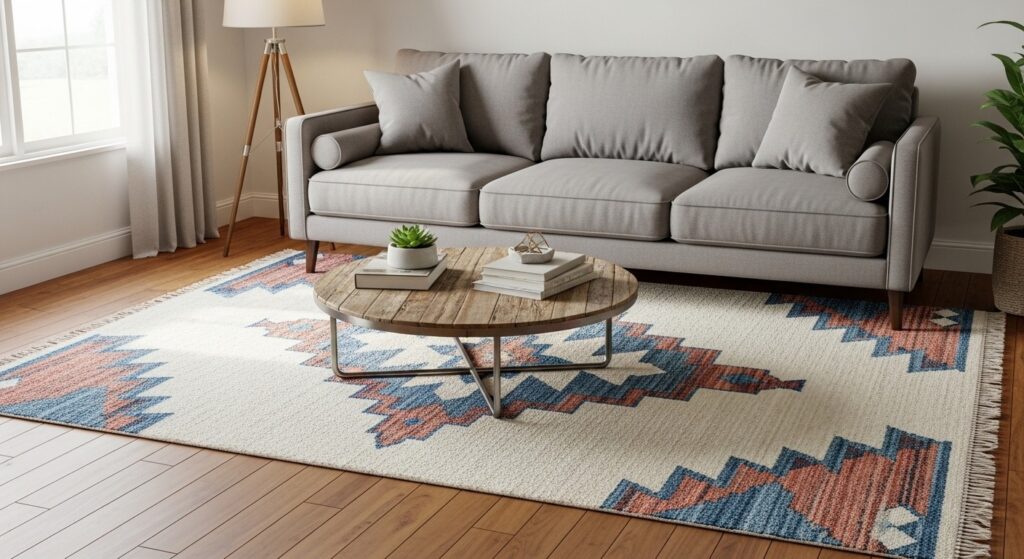
Quick size reference:
- Studio apartment: 4×6 ft or 5×7 ft
- Small living room under 12×12 ft: 5×8 ft is the sweet spot
- Slightly roomier space: 6×9 ft or 8×10 ft
- Rule of thumb: leave 12 to 18 inches of bare floor showing around the rug edges
2. Placement Rules That Work
Getting the size right is half the battle. Where you actually put the rug determines how well it anchors the room. In a small living room, the rug works as a visual zone marker — it tells the eye where the seating area begins and ends, which makes even a tight space feel more intentional and organized.
The most reliable approach is the “front legs on” method. Position your sofa so its front two legs rest on the rug, and do the same for any armchairs in the grouping. This creates a clear visual connection between all the seating pieces without requiring a rug large enough to fit every leg entirely on top. It’s the method professional stylists reach for most often, and it works in almost every layout.
If your living room shares space with a dining area or home office corner, use the rug to define the seating zone only. That visual separation actually makes each area feel more purposeful and spacious. One placement to avoid: a rug centered in the room with no furniture touching it. That floating look tends to feel unfinished and draws attention to how small the space is.
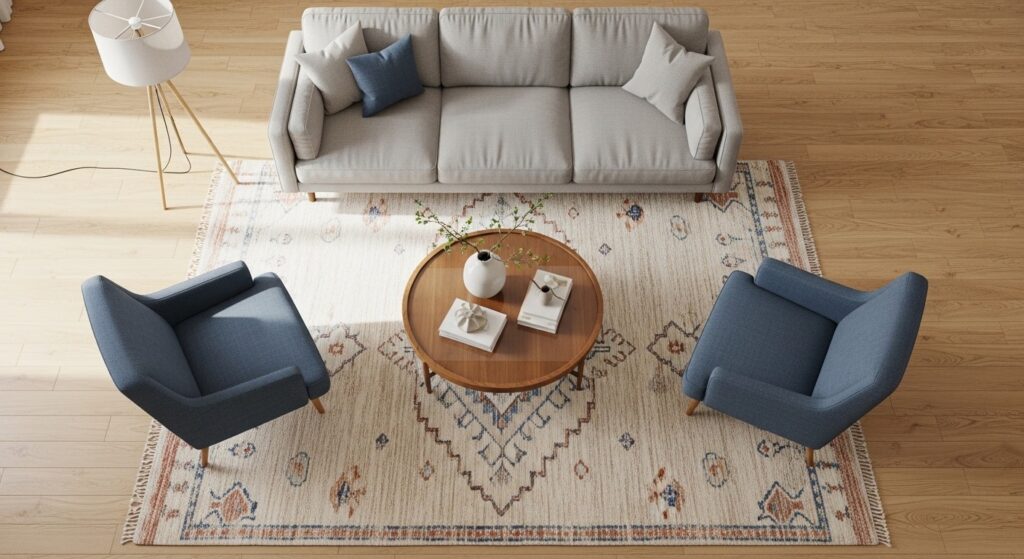
| Pro tip: Use painter’s tape to map out your rug dimensions on the floor before buying. Live with the outline for 24 hours — you’ll see immediately whether the size and placement feel right in your actual room. |
3. Light vs Dark Rugs
Color has a bigger effect on how a room feels than most people expect. Light rugs — creams, ivories, soft sand tones, pale blush — reflect more light around the room and make the floor area feel open and expansive. If your small living room already feels a little dark or boxed-in, a light-colored rug is one of the easiest ways to lift it.
Dark rugs aren’t off the table, though. A deep navy, forest green, or warm charcoal rug creates bold contrast and makes furniture pop against it. In a well-lit room with pale walls, a dark rug adds richness and a sense of grounded coziness. The main thing to watch out for: in a space that doesn’t get much natural light, a dark rug can make things feel heavier than you’d like.
For most small living rooms, the most versatile choice lands somewhere in the middle — a warm neutral like camel, dusty rose, muted terracotta, or soft warm gray. These tones work with nearly any furniture color, hide everyday wear and light dust between cleanings, and keep the room feeling open without washing everything out.
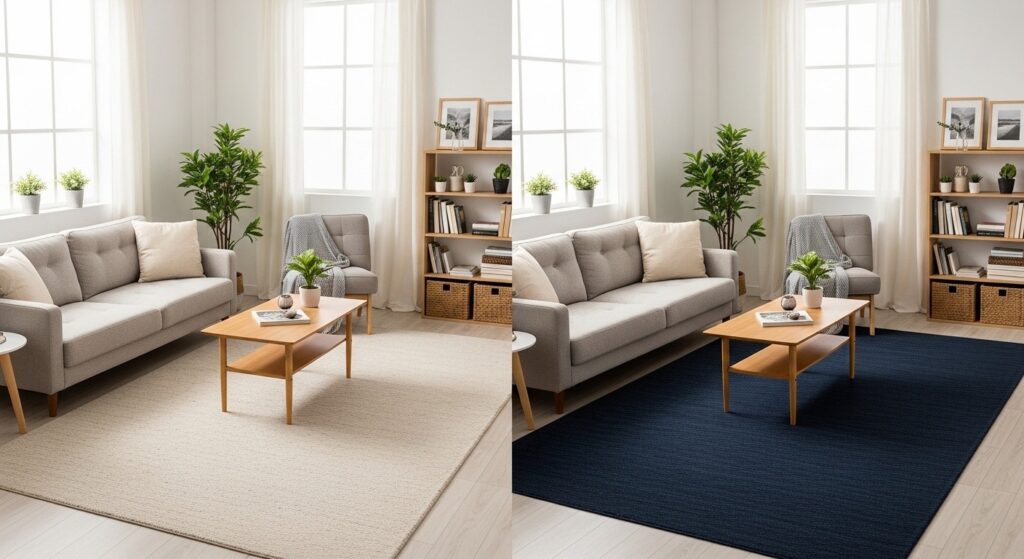
- Light rug: opens up the space, works especially well in darker or north-facing rooms
- Dark rug: adds drama and warmth, best in bright well-lit rooms with pale walls
- Mid-tone neutral: the most flexible option for small spaces with mixed lighting
4. Pattern Considerations
Patterns can be genuinely fun in a small living room — or they can visually overwhelm the whole space. The difference comes down to scale and restraint. As a general rule, the smaller your room, the simpler your rug pattern should be. That doesn’t mean boring. It just means choosing patterns that add interest without adding visual noise.
Geometric designs with open, airy spacing tend to perform really well in small rooms. A simple grid, a thin stripe, a subtle diamond repeat, or a tonal texture will add character without competing with your furniture or your eye trying to rest. What to avoid: large-scale florals, very busy traditional medallion patterns, and anything that looks like it belongs in a much larger room — these patterns typically shrink a small space visually.
If you love a bold patterned rug and you’re committed to it, keep everything else in the room calm. A statement rug alongside patterned throw pillows, textured curtains, and a decorative gallery wall is usually too much for a small space to carry all at once. Give the rug the spotlight and let the surrounding pieces play a supporting role.
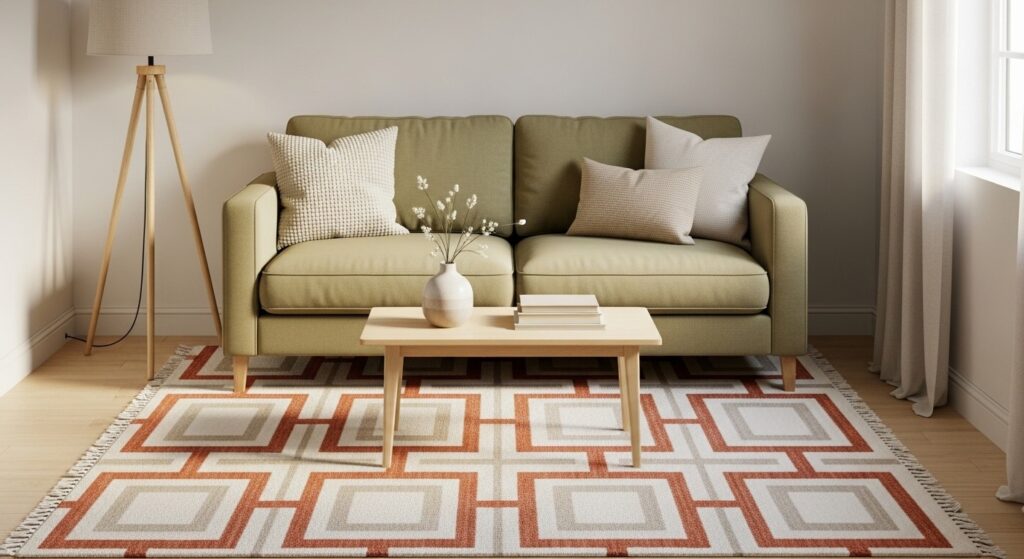
- Best patterns for small rooms: simple geometrics, thin stripes, tonal textures, subtle repeating motifs
- Use carefully: medium-scale florals, abstract art-style prints
- Approach with caution: large-scale traditional medallions, very busy all-over patterns
5. Layering Rugs in Small Spaces
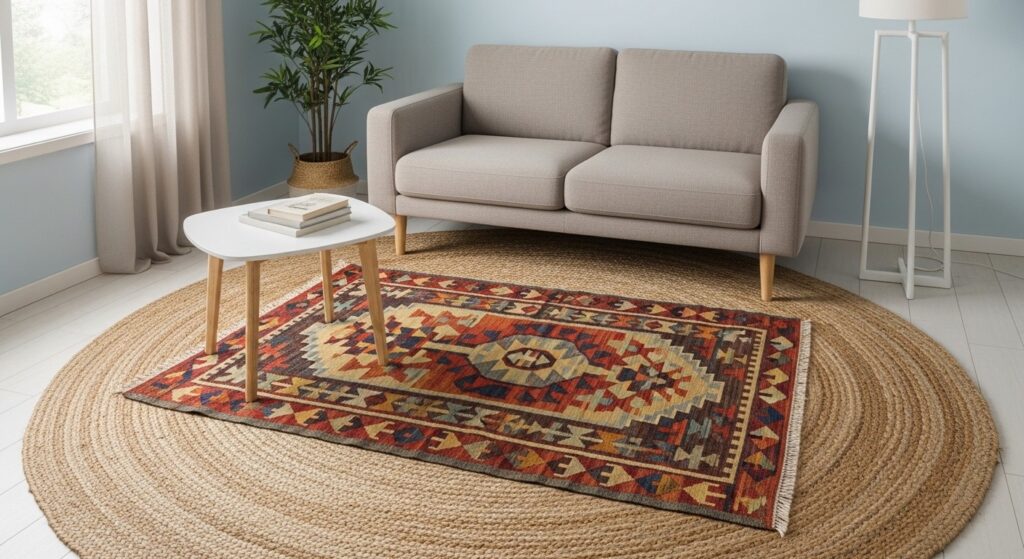
Layering two rugs in a small space sounds like a recipe for chaos, but it can actually be one of the cleverest tricks in a compact room. The reason it works: you use a simple, affordable base rug to cover the main floor area, then layer a smaller statement piece on top to add texture and personality — without needing to splurge on one large, expensive rug.
The layering combination that works most reliably is a large flat-weave or natural fiber rug as the base — jute, sisal, and cotton all work beautifully — topped with a smaller patterned or richly textured rug in front of the sofa. The flat, neutral base keeps the floor calm, while the top layer does the decorative heavy lifting. Keep the base simple so the two layers complement rather than compete with each other.
One rule you should follow when layering in a small room: make the size difference obvious. If both rugs are close in size, they’ll look accidental rather than intentional. Aim for the top rug to be at least two feet smaller on each side than the base. That clear difference in scale is what makes the layering look considered and styled.
6. Easy-Clean Options
In a small living room, your rug sees a lot of life. Foot traffic, food and drinks, work-from-home crumbs, the occasional spill — it all lands on that floor covering. So easy cleaning isn’t a nice-to-have. It’s genuinely important, especially in an apartment where you might not have room for heavy equipment or a yard to drag a wet rug into.
Flatweave rugs are probably the most practical option for real everyday life. No deep pile means no crumbs, dust, or pet hair getting trapped below the surface. Most flatweave cotton and synthetic rugs can go straight into a large-capacity washing machine when they need a proper clean. Indoor-outdoor rugs made from polypropylene are another excellent choice — they resist stains, dry quickly, and handle spills with minimal fuss. The designs available now are genuinely attractive, nothing like the utilitarian styles from a decade ago.
Wool rugs are naturally resistant to staining and have a long lifespan, which makes the higher upfront cost worthwhile if you’re buying for the long term. Whatever material you land on, a pattern or subtle texture will help disguise everyday dirt between cleaning sessions. A solid light-colored rug in a high-traffic living room is a beautiful idea in theory — just be prepared for the maintenance that comes with it.
- Best for easy care: flatweave cotton, polypropylene indoor-outdoor, machine-washable options
- Worth the investment: wool (naturally stain-resistant, durable over many years)
- Consider carefully: high-pile shag and solid light colors in busy households
- Tip: a rug pad protects both the rug and the floor beneath, and prevents sliding
Common Mistakes to Avoid
Even with the right rug, a few common habits can quietly undermine the whole look. Here are five to keep in mind as you style your small living room:
✗ Pushing all furniture against the walls
This is the most instinctive thing to do in a small room — and one of the least effective. Pulling pieces a few inches away from the walls actually creates breathing room around each piece and makes the space feel larger, not smaller.
✗ Using oversized furniture
A sofa that runs the full length of a wall, a coffee table that blocks natural movement, or a bulky armchair in an already-tight corner — oversized pieces make any rug look wrong because they overwhelm the floor plan entirely before the rug even has a chance.
✗ Ignoring vertical space
Small rooms feel more expansive when the eye is drawn upward. Hanging curtains close to the ceiling, choosing taller storage pieces, and keeping lower wall areas relatively calm all help. Your rug works harder when the whole room is well balanced vertically.
✗ Too many small decor items
Lots of tiny objects — small frames scattered across a wall, collections of little figurines, clusters of mini candles — fragment a small room visually. They create visual noise that competes with your rug and makes the space feel cluttered. A few larger, well-chosen pieces almost always read better.
✗ Poor lighting choices
A single ceiling light flattens everything in a small room, including your rug. Layering floor lamps, table lamps, and softer ambient sources makes the room feel dimensional and alive. Good lighting lets your rug actually show up the way you imagined it would.
Frequently Asked Questions
What is the best sofa for a small living room?
The best sofa for a small living room has a streamlined shape, slim or tight arms, and exposed legs rather than a skirted or boxed base. Exposed legs lift the sofa visually off the floor, letting light pass underneath and making the room feel more open. A two-seater or a compact three-seater in a solid, neutral color tends to work best — it anchors the space without dominating it.
Look for sofas where the overall depth and length are proportional to your room. A 90-inch sofa in a 12-foot room leaves very little space for anything else, including a rug that fits correctly. Once you have furniture that fits the room, everything else — including your rug choice — becomes much easier to get right.
For more room-layout inspiration, our guide to 50 Small Living Room Ideas covers sofa placement, furniture scale, and floor plan ideas in detail.
How do I make my small living room look bigger?
Start with the rug: the right size (not too small), positioned so the front legs of your sofa and chairs sit on top of it. This grounds the furniture in a single cohesive zone, which makes the room feel organized rather than cramped. From there, use mirrors strategically — a large mirror on one wall can genuinely double the visual impression of the space.
Choose furniture with legs over pieces that sit directly on the floor. Keep your palette consistent — too many competing colors and materials fragment a small room visually. Hang curtains as close to the ceiling as possible, and make sure your lighting layers rather than relying on a single overhead source.
Our full guide on Small Living Room Color Ideas goes into detail on specific palette combinations that open up compact spaces.
What colors make a small room look larger?
Light, cool, and neutral tones are the most reliable choices for making a small room feel more spacious. Soft whites, warm creams, pale grays, and light greiges reflect natural light and keep walls from feeling like they’re closing in. The key is tonal consistency — when your walls, ceiling, and floor covering share a similar color family, the eye doesn’t land on sharp contrasts that emphasize the room’s edges.
That said, you don’t have to go all-white to get the effect. Warm neutrals like sandy beige, gentle terracotta, and soft sage green all create a sense of openness while adding personality. The trick is keeping the overall palette fairly cohesive rather than introducing many competing tones.
For a deeper look at this topic, our Small Living Room Color Ideas guide walks through specific paint and decor combinations that work in tight spaces.
Should I use a rug in a small living room?
Yes — definitely. Without a rug, small living rooms often feel unfinished. Furniture pieces float without a visual connection to each other or the floor, which makes the space harder to read as a cohesive room. A well-chosen rug creates a defined seating zone, softens hard flooring, and adds a layer of texture and warmth that genuinely makes a room more comfortable to spend time in.
The important caveat is that the rug needs to be the right size and in the right place. A rug that’s too small for the furniture grouping actually does more visual damage than no rug at all — it draws attention to the wrong proportions. Follow the sizing and placement guidance in this post, and you’ll find the rug becomes the element that makes everything else in the room click.
For more ideas on styling your space, take a look at our Small Living Room Decor Ideas guide — it covers textiles, accessories, and layout tips that pair well with a great rug choice.
Ready to Find Your Rug?
A rug really can transform a small living room — not just aesthetically, but in how the whole space feels to live in. It’s a foundation, a focal point, and a way of telling the room where to organize itself. When the size is right, the placement is intentional, and the style fits the rest of the space, everything else in the room seems to fall into place around it. You don’t need more square footage. You mostly just need a better plan.
Start with your measurements. Tape out the dimensions on the floor. Try a few options before committing. Take it one step at a time — this doesn’t have to be done in a single weekend. Every small improvement adds up to a room that genuinely feels like home. You’ve got this.
KEEP READING