Minimalist Living Room Ideas: Less Really Is More
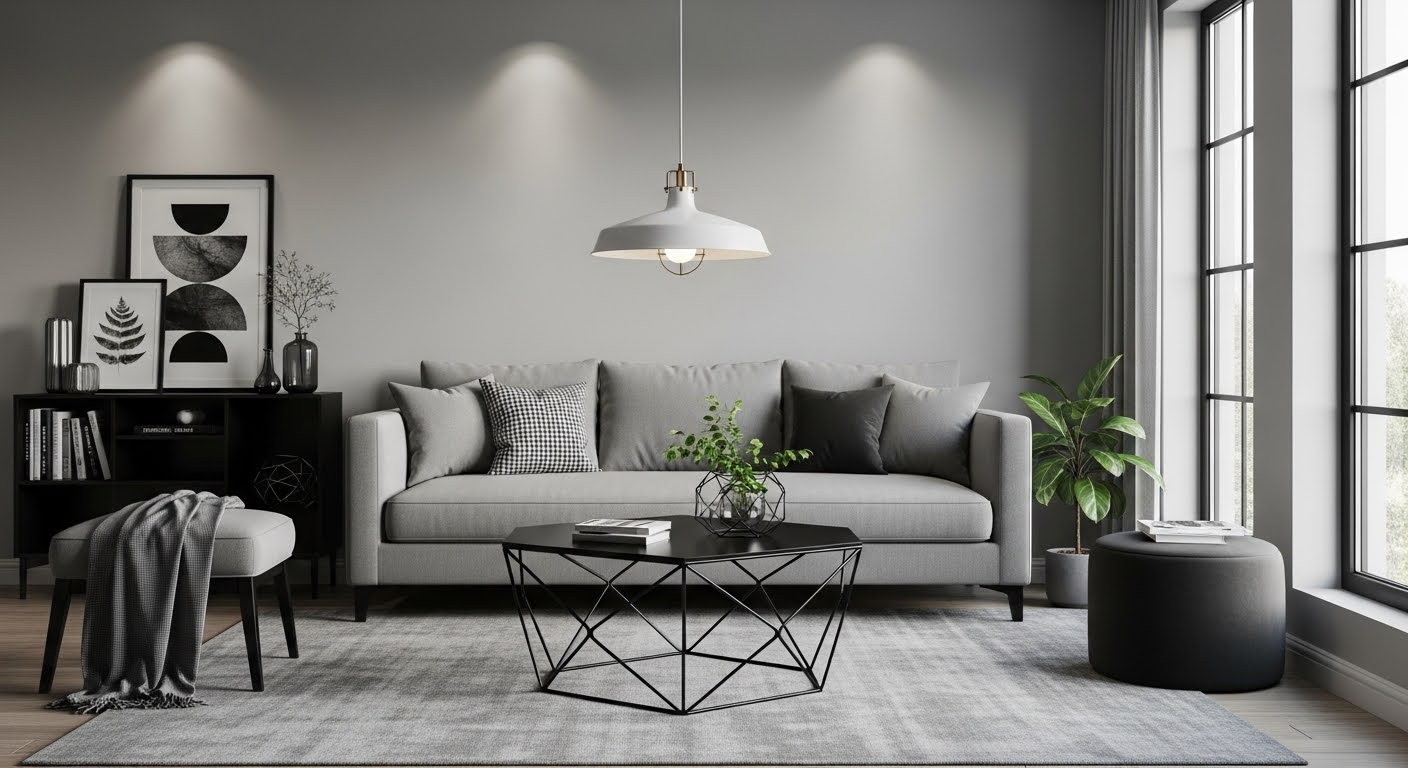
If your living room feels cluttered and a little chaotic, you’re probably not looking for more things to add — you’re looking for a way to cut through the noise. That’s exactly what minimalist living room ideas can do. And here’s the part most people miss: the goal isn’t a bare, cold room that looks like a hotel lobby. It’s a space that actually feels like yours — just without all the extra stuff you never really wanted in the first place.
Small apartments get the worst of it. When you’re working with limited square footage, every item that doesn’t belong makes the room feel even tighter. Good news: minimalist decor for your living room works especially well in compact spaces, because removing visual noise is one of the most effective ways to make a small room feel bigger. No renovations required.
In this post, you’ll learn what minimalism actually means in practice, how to edit what you already have, which furniture choices make the biggest difference, and how to keep your space feeling warm and personal rather than sterile. By the end, you’ll have a clear plan — and a room you actually enjoy being in.
Quick Summary
WHO THIS IS FOR
Design enthusiasts, clean-line lovers, and anyone ready to refresh their space
TIME TO READ
8 min
TOP 3 TAKAWAYS
1. What Minimalism Really Means
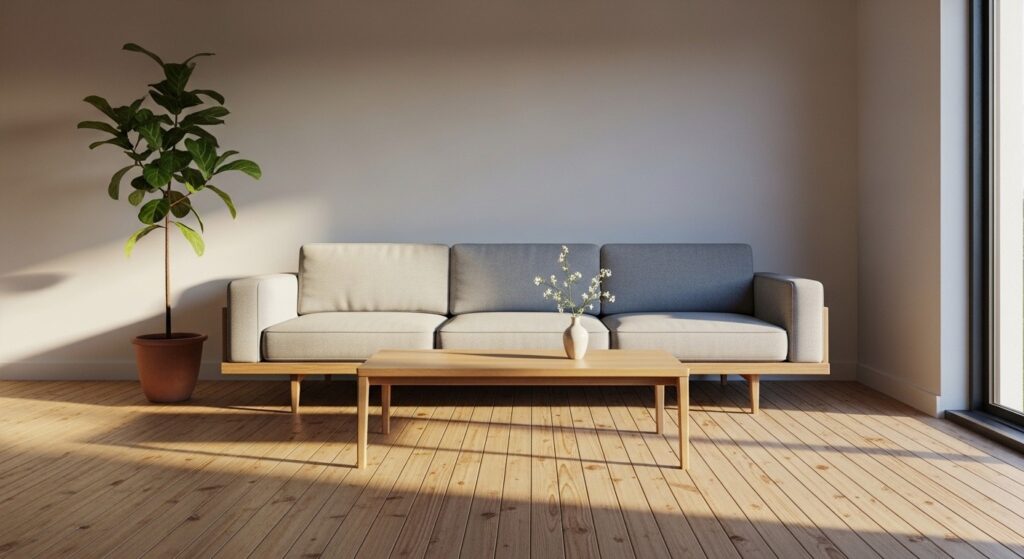
Let’s clear something up right away: minimalism isn’t about owning as little as possible, and it’s definitely not about making your home look like a furniture catalogue. At its heart, it’s a single question you ask about everything in your room — does this earn its place? If something doesn’t serve a purpose, reflect your taste, or make you feel good, it’s a candidate for removal. That’s the whole philosophy, and honestly, it’s pretty freeing once it clicks.
A lot of people hold back because they’re afraid of going too far. They picture empty walls, bare floors, and a room that feels cold or impersonal. But there’s a real difference between a clutter-free living room and an empty one. Think of it this way: when you strip away the noise, the things you keep become more meaningful. One piece of art you genuinely love has ten times the impact of a wall filled with things you bought because the shelf looked empty.
For anyone living in a smaller apartment, this approach is genuinely practical. Visual clutter makes rooms feel cramped — removing it makes them feel larger, lighter, and easier to breathe in. No knocking down walls needed. Just a clearer eye for what stays and what goes.
- Minimalism is about intentional keeping, not deprivation
- Every item should have a clear reason to be there
- Less visual noise = a room that feels noticeably bigger
- Works beautifully in small apartments and compact layouts
2. The Edit Process
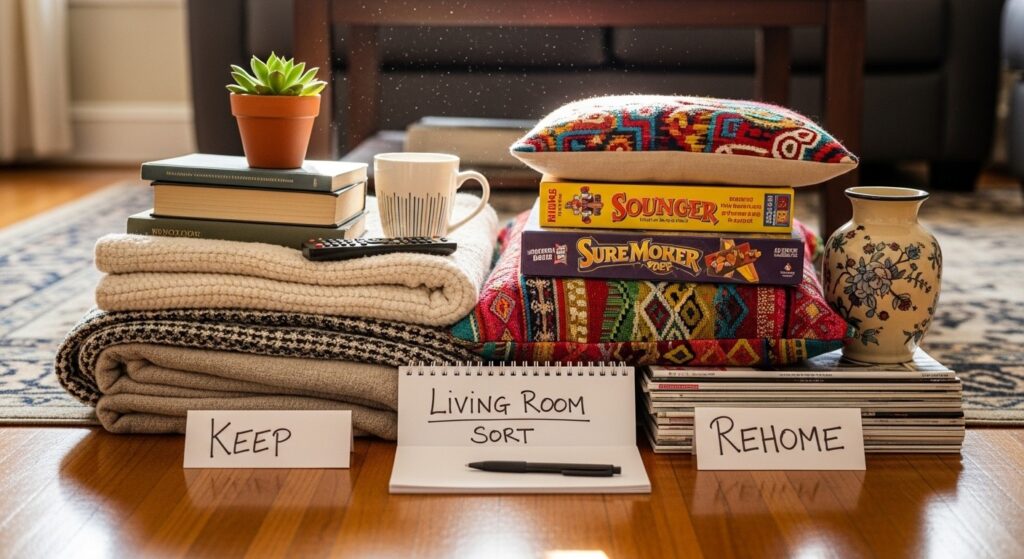
Here’s the step most people skip — and it’s the most important one. Before you buy a single new thing, edit what you already have. Pull everything movable out of the room. Every cushion, candle, side table, stack of books, random decorative object. Get it all into the hallway. Then, only put back the things you’d genuinely miss.
You’ll probably be surprised how little that turns out to be. Most living rooms are holding two or three times as many objects as they need. Start by removing the obvious: things that are broken, things you’ve never liked, things you kept out of habit. Then take a second pass at the “maybes” — the items you’re keeping just because they were a gift, or because they were expensive, or because you haven’t given yourself permission to let go of them yet.
Work in rounds. The first pass is easy. The second one is harder. The third is where real clarity happens. And here’s something nobody tells you: once you’ve done this process once, it gets so much easier to maintain. The room starts working with you instead of against you.
- Empty the room before you redesign — physically, not just mentally
- Return only what you’d genuinely miss
- Edit in multiple rounds; each one gets more honest
- Donate or rehome anything that doesn’t pass the test
3. Quality Over Quantity
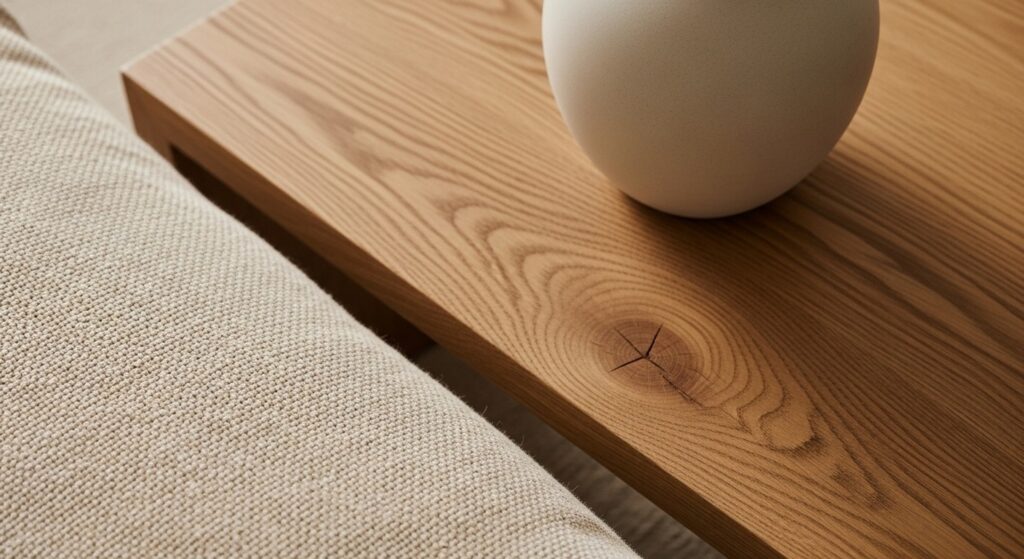
Once you’ve edited down, you might find a few gaps — a worn rug that needs replacing, a side table that never quite fit. This is actually your opportunity to buy better, not more. In a simple living room design, every piece is on full display. There’s nowhere for a cheap or careless purchase to hide. So when you do spend money, spend it on the things you interact with every single day.
This doesn’t mean you need a big budget. Quality, in the context of minimalist decor, is about materials, durability, and honesty of design. A solid wood coffee table with good proportions will anchor a room for decades. A trendy piece made of composites and wishful thinking might look fine for a season. Think about cost per year of use, not just the number on the price tag.
The side benefit? Buying fewer, better things slows down the cycle of replacing and refreshing. You stop accumulating things as a habit. Your room stabilizes. And ironically, you save money over time — because you’re not constantly upgrading things that never quite worked in the first place.
4. Functional Furniture Only
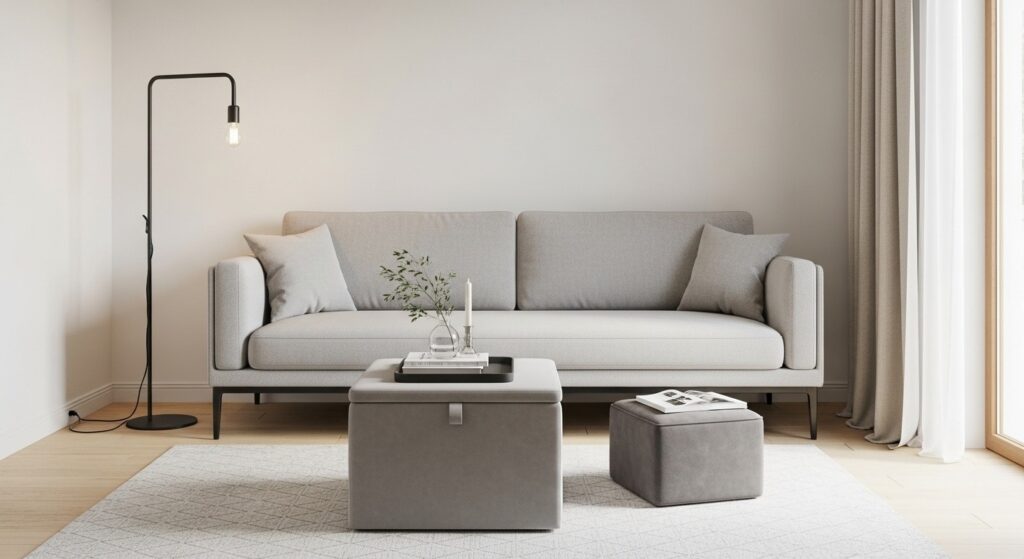
In a minimal space, furniture has to justify its presence. The best pieces do two jobs at once — a storage ottoman that doubles as a coffee table, a low-profile sofa that keeps sightlines open, a console table that creates surface space without eating into the room. Before you bring anything in, ask: what does this do? If you can’t answer that in five seconds, think twice.
The pieces to avoid are the ones that exist purely to fill visual space — oversized accent chairs that nobody sits in, decorative ladders that hold nothing, multiple side tables clustered together because the corner looked bare. These are just clutter with better styling. In a well-edited room, every piece of furniture is a deliberate decision, not a default.
Scale matters more than most people realize. A sofa that’s even slightly too large for a room will dominate every other decision around it. Always measure before you buy — not just the item, but the clearance around it, the path to the door, the space between the sofa and the coffee table. Furniture that floats in a room with breathing space around it always feels better than furniture that’s fighting for territory.
- Every furniture piece should have at least one clear function
- Multi-functional pieces earn their footprint twice over
- Match scale to room size — always measure before buying
- Visible floor space makes any room feel larger and calmer
5. Negative Space Importance
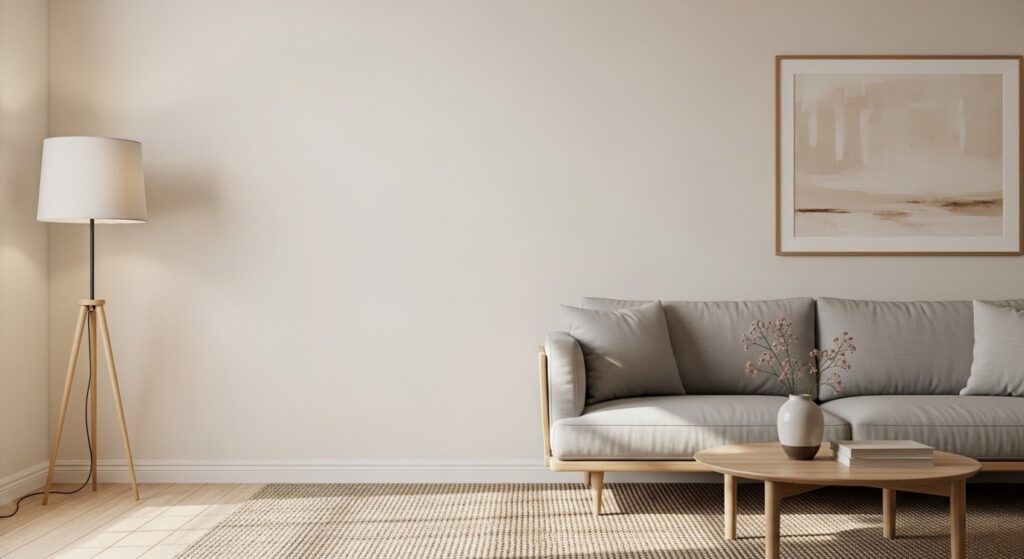
Negative space sounds like a design-school term, but it just means the empty areas around and between your things. And in a minimalist room, that “empty” space is doing real work. It gives the eye somewhere to land. It lets your chosen pieces breathe. It’s what creates that sense of calm you feel when you walk into a well-edited room — even if you can’t quite put your finger on why.
Most of us are conditioned to fill negative space. An empty wall feels unfinished. A bare shelf feels incomplete. But try living with it for a week before adding anything. You’ll often find that the absence stops bothering you faster than expected — and what you notice instead is how much better the room already feels. Restraint is a design choice, not a failure.
In small living rooms especially, negative space is what keeps a compact layout from feeling cramped. Aim for good clearance around your main seating. Leave one wall intentionally bare. That one empty wall will do more for the room than almost anything you could hang on it.
6. Storage That Hides Everything
A clutter-free living room doesn’t mean a life without possessions. It means every possession has a home — and most of those homes are hidden. Great storage is the behind-the-scenes engine of every beautiful minimal space. The goal is to conceal what you need but don’t want to look at, so that the things you choose to display can actually be seen.
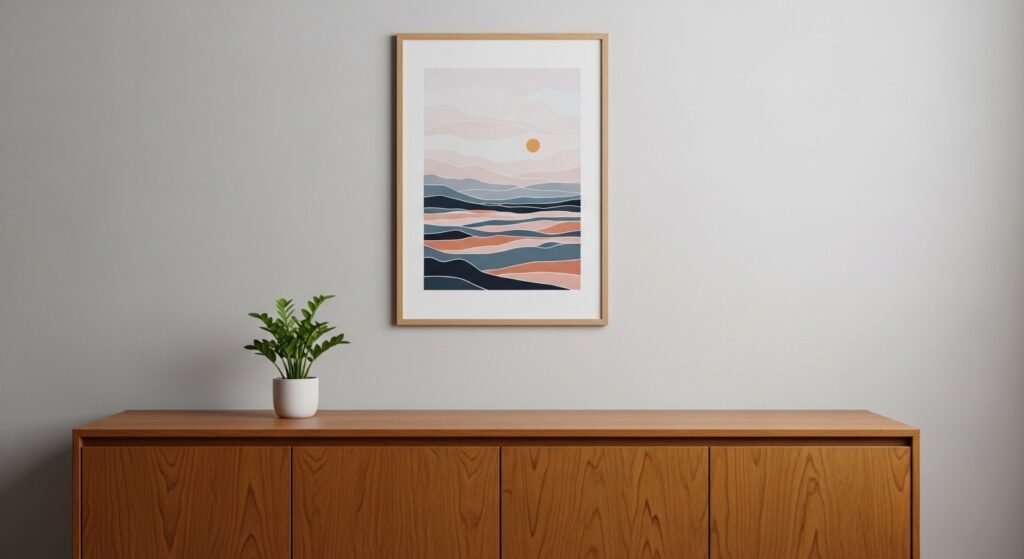
Closed storage wins in most small spaces. A media cabinet with doors hides cables, remotes, and all the visual noise that comes with modern tech. Baskets on shelves create tidy pockets for the things that accumulate — chargers, small items, the miscellaneous stuff that ends up on surfaces. When you’re shopping for new furniture, treat built-in storage as a priority feature, not a bonus.
When everything has a designated home, it gets returned there. Surfaces stay clear without constant effort. Cleaning becomes quicker. And the room maintains that calm, curated feel day to day — not just after a big tidy-up. That’s the real long-term payoff of getting your storage right.
- Closed storage keeps surfaces permanently clear
- Every item needs a designated home — not just a spot
- Baskets, bins, and boxes are a minimalist’s practical toolkit
- Prioritize furniture with built-in storage when you’re shopping
7. Color in Minimalist Design
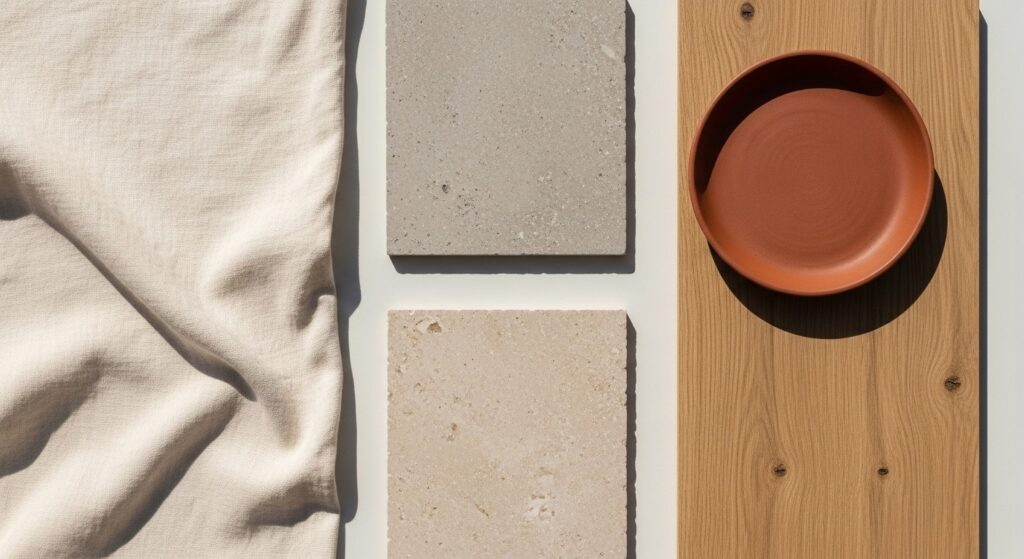
You don’t have to go all white. The classic minimalist palette is neutral — creams, warm grays, taupes, soft off-whites — but neutral doesn’t mean flat or boring. A room built on layered neutrals with varied texture can feel incredibly rich. The key is restraint: pick two or three tones and let them carry everything. Trying to work with more usually results in a room that feels busy rather than curated.
If you love color, you can absolutely bring it in — just contain it. One accent tone, used in a few deliberate places, creates a point of interest without breaking the overall calm. A terracotta vase, a dusty blue cushion, a single sage throw. The surrounding neutrals will make that accent pop far more than it ever would in a room where everything is competing at once.
The easiest starting point is your floors and walls — the fixed elements you’re already working around. If your floors are warm oak, lean into earthy, warm-toned neutrals. If your walls are a cool white, soft blues and sage greens will feel natural. Let those fixed elements guide the palette, and you’ll avoid a lot of expensive course-corrections later.
8. Making Minimalism Warm
The most common worry people have about going minimal is that they’ll end up with a cold, lifeless room. It’s a fair concern — strip a room and stop there, and yes, it can feel stark. But warmth in a minimal space doesn’t come from filling surfaces. It comes from material choices, lighting, and a few well-placed organic elements. Get those three things right, and the room will feel genuinely inviting.
Texture is your main warmth tool. A chunky knit throw draped over a sofa arm. A woven rug underfoot. A linen cushion with visible fabric weave. Rough terracotta next to a smooth matte wall. These tactile contrasts create a sense of comfort without adding visual clutter. You feel the warmth even when you’re just looking at the room.
Lighting is the other piece people underestimate. Overhead lighting alone makes any room feel utilitarian. Add a floor lamp in one corner, a table lamp on a side table, and suddenly the room has depth and atmosphere after dark. Warm-toned bulbs make a significant difference to how a space feels in the evening. And one well-placed plant — particularly something with good leaf structure and a bit of height — adds a kind of organic life that no decorative object can quite replicate.
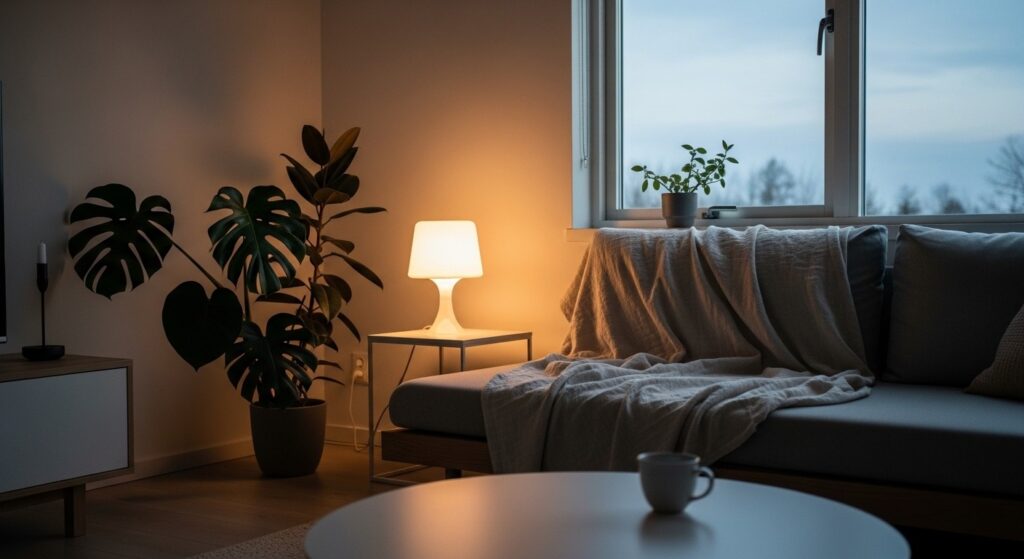
- Layer textures to create warmth without adding visual noise
- Add multiple light sources — never rely on overhead alone
- Warm-toned bulbs (around 2700K) shift the mood of a room after dark
- One well-chosen plant does more for a room than ten small objects
Reading About – Modern Living Room Ideas
Common Mistakes to Avoid
Even when you go in with great intentions, certain habits can quietly undo a minimalist redesign. Here are four that come up again and again — and how to sidestep them.
✘ Not measuring first: A sofa that looked perfectly scaled in the showroom can overwhelm your entire living room. Measure your space, sketch out a rough floor plan, and map furniture placement before you commit to anything. Include doorways, windows, and clearance paths — not just the walls.
✘ Ignoring existing elements: Your floors, walls, trim, and fixed light fittings are part of the room whether you work with them or not. Buying new furniture without accounting for existing undertones and textures is one of the most common reasons a room feels “off” even when each individual piece is perfectly nice on its own.
✘ Trend-chasing over personal style: Minimalist rooms on social media can look very uniform — the same sofa shapes, the same light fixtures, the same wall treatments. Trends are popular for a reason, but copying one doesn’t guarantee a room that feels like you. Spend time figuring out what you actually love before you open an inspiration board. Your room will have far more staying power for it.
✘ Skipping the planning phase: Editing and redesigning on impulse — clearing things out on a Sunday and buying replacements by Monday — almost always leads to decisions you’ll second-guess. Live with each stage for a week or two before spending money. The room will tell you what it actually needs, rather than what you think it needs in the moment.
Frequently Asked Questions
Q1: What’s the most important element to focus on first?
Start with your furniture layout and scale — it has the biggest impact on how a room feels, and it costs nothing to change. Before you touch color, storage, or any decorative details, make sure every piece of furniture is correctly sized for your space and positioned to allow good flow and open floor area.
Once the layout feels right, turn your attention to clearing surfaces. A coffee table, side table, or shelf with nothing on it creates an instant sense of calm. That combination — a good layout plus clear surfaces — does more work than almost any styling decision you can make on top of it.
If you can only do one thing today, clear every horizontal surface in the room and leave only the items you’d display in a nice hotel room. That single action will show you more clearly than anything else what the space is capable of.
Q2: How do I actually start this project as a beginner?
Start with the edit, not a shopping list. Before you plan anything new, remove everything from the room that you physically can, and only return what genuinely earns its spot. The physical act of pulling things out — rather than just mentally noting them — forces honest decisions in a way that planning alone never does.
From there, work through the room in layers: furniture placement first, then storage solutions, then lighting, then decorative details. Tackling one category at a time keeps the project manageable and means you’ll see real, visible progress at each stage.
Give yourself permission to live with less for a few weeks before filling any gaps. More often than not, you’ll find the things you thought were missing simply stop mattering once the clutter is gone.
Q3: What’s the typical budget range for a minimalist living room refresh?
It varies widely, because the approach is inherently flexible. A pure editing and rearranging project costs nothing — and it can transform a room entirely. Many people find that removing and reorganizing what they already own delivers around eighty percent of the result they were after.
If you do need to replace key pieces, invest based on quality over quantity. A rough priority order: seating first (the most-used piece in the room), rug second (it anchors everything else), then lighting. Those three changes alone can shift the feel of a space more than replacing every smaller item combined.
Full refreshes including a new sofa, rug, lighting, and storage vary enormously depending on what already needs replacing. The encouraging part is that a minimalist approach tends to reduce total spending over time — you simply buy less, and you think more carefully before each purchase.
Q4: How long does it take?
The editing phase can happen in a single afternoon or weekend, and for many people, that one session delivers a visibly different room. Deciding what stays and what goes is the most time-intensive part — but it’s also the most immediately rewarding.
If you’re sourcing new pieces, build in realistic timelines. Furniture can take weeks or even months to arrive, depending on where you’re buying. Work with what you have in the meantime — you may find you need considerably less than you thought by the time your new items show up.
The deeper shift — from accumulating by habit to choosing with intention — takes a few months to settle in. Give yourself that time before deciding anything is missing. Most people find the spare room grows on them rather than feeling incomplete.
Q5: What mistakes should I absolutely avoid?
The biggest one is mistaking minimalism for emptiness and removing warmth along with clutter. A successful minimal room still has texture, light, and personality — it just has fewer things competing with those elements. Stripped-back doesn’t have to mean cold.
Second: making impulsive purchases to fill the gaps left by editing. Sit with each stage of the project for a while before spending money. Your instincts about what’s missing will sharpen considerably after a few weeks of living in a clearer space.
And finally: building your room around what’s trending rather than what you genuinely love. A minimalist space designed around your actual taste will feel right for years. One built around a mood board that was popular this season will feel dated quickly — and you’ll end up starting over. Start with your own preferences, not someone else’s.
Ready to Start?
Minimalist living room ideas work because they address the actual problem: too much competing for your attention in the space where you’re supposed to relax. And the solution, it turns out, doesn’t require a bigger apartment, a bigger budget, or any design experience. It just requires a clear afternoon and permission to stop filling space for the sake of it.
Start small. Clear one surface today. Move one piece of furniture and see how the room breathes differently. Buy one thing you love rather than three things that are just fine. The room you want is built through a series of honest, thoughtful decisions — not one grand overhaul that happens all at once. Trust the process. Less really is more.