
Modern Living Room Lighting: Fixtures That Make a Statement
You flip the switch and one flat ceiling light floods the whole room. Everything you love about the space disappears under that harsh, even glow. Sound familiar? Lighting is probably the single most overlooked part of living room design — and yet it’s the one thing that can make your space feel bigger, warmer, and way more intentional without touching a single piece of furniture.
Here’s the good news: modern living room lighting doesn’t have to be complicated, expensive, or cold. Whether you’re in a 500-square-foot apartment or just trying to refresh a room that never quite feels right, contemporary light fixtures can absolutely work with your space instead of fighting it.
In this guide, you’ll learn how to layer light like a designer, pick the right fixtures for your layout, and choose modern lamps for your living room that actually pull everything together. By the end, you’ll have a clear, doable plan — with plenty of ideas you can start on this weekend.
Quick Summary
WHO THIS IS FOR
Modern design lovers, clean-line fans, and anyone refreshing a small or rental space.
TIME TO READ
5 min
TOP 3 TAKAWAYS
1. Why Lighting Matters in Small Spaces
In a compact living room, lighting pulls double duty. It shapes how spacious your room feels and how warm — or cold — the whole atmosphere reads. One overhead bulb creates flat, uninviting light that visually shrinks a room and makes even your nicest furniture look a little sad.
Modern living room lighting works differently. Instead of relying on one big source, you spread warmth across several points in the room. This creates visual depth — which is actually pretty magical, because depth makes the eye perceive more space than is physically there.
Think of it this way: well-placed light pulls attention toward the best parts of your room and lets the less-great corners softly fade away. That’s not a trick. That’s just good design doing its job.
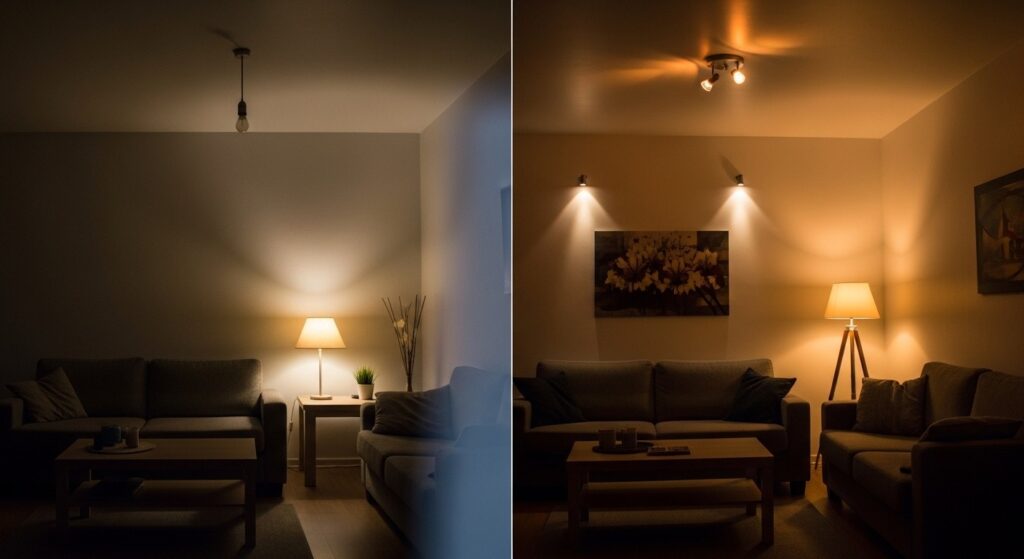
- Light at eye level feels more intimate than ceiling-only light
- Warm bulb tones (2700K–3000K) make small rooms feel cosy, not cramped
- Multiple pools of light add visual rhythm and depth to a minimal layout
2. Natural Light Maximization Tips
Before you buy a single fixture, look at your natural light. Daylight is the most flattering, completely free resource you have — and most people actively block it without realizing. Heavy curtains, dark rugs near windows, furniture arranged away from natural sources … these things quietly kill a room’s brightness.
Swap thick drapes for sheer linen panels in off-white or warm ivory. They filter glare while keeping the room luminous. And here’s a trick that’s genuinely free: hang your curtains as high and wide as possible. This makes windows look much larger and floods more light toward the centre of the room.
If privacy is a concern, frosted window film on the lower half of your windows solves the problem cheaply and neatly. You keep the light, lose the fish-bowl feeling, and spend nothing on extra fixtures.
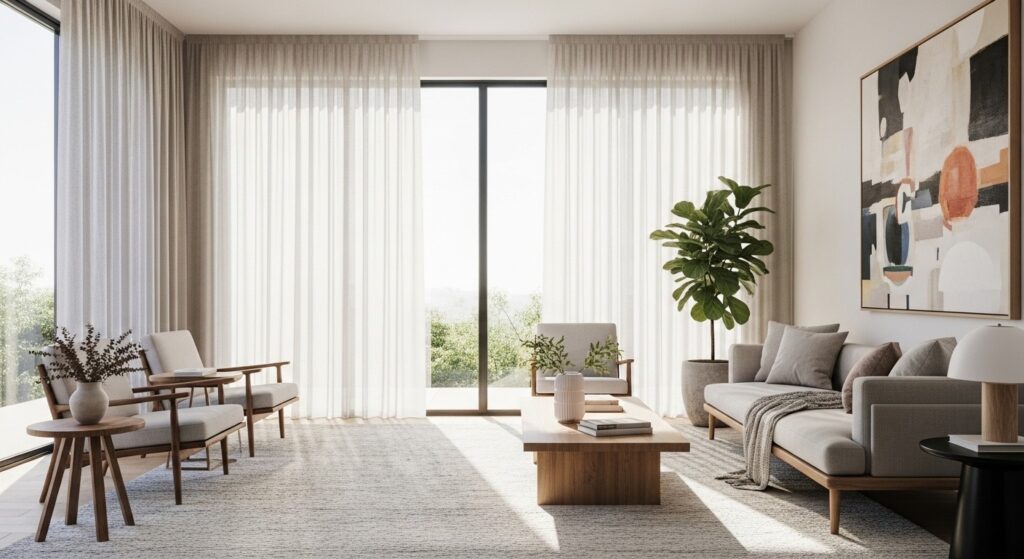
- Position mirrors opposite windows to double reflected daylight
- Choose light-toned rugs and furniture near windows to bounce light inward
- Use semi-sheer Roman blinds for a clean, modern look with maximum light
- Trim outdoor plants that block window light from outside
3. Overhead Lighting Options
Your overhead fixture is the first thing guests notice when they walk in, so it’s worth making it count. In modern interiors, statement lighting ideas often start at the ceiling. One sculptural pendant or a well-chosen semi-flush mount can set the entire design tone of a room — without a single piece of furniture changing.
For low ceilings, a flush-mount drum shade in matte black, brushed brass, or warm white keeps lines clean and modern without pulling the ceiling down further. Higher ceilings can handle a geometric pendant or a cluster of globe drops — something with presence that draws the eye upward.
One small upgrade that makes a huge difference: a dimmer switch. It often costs less than a nice candle and gives you full control over mood — bright for cleaning, warm and low for hosting, something in between for a relaxed evening in.
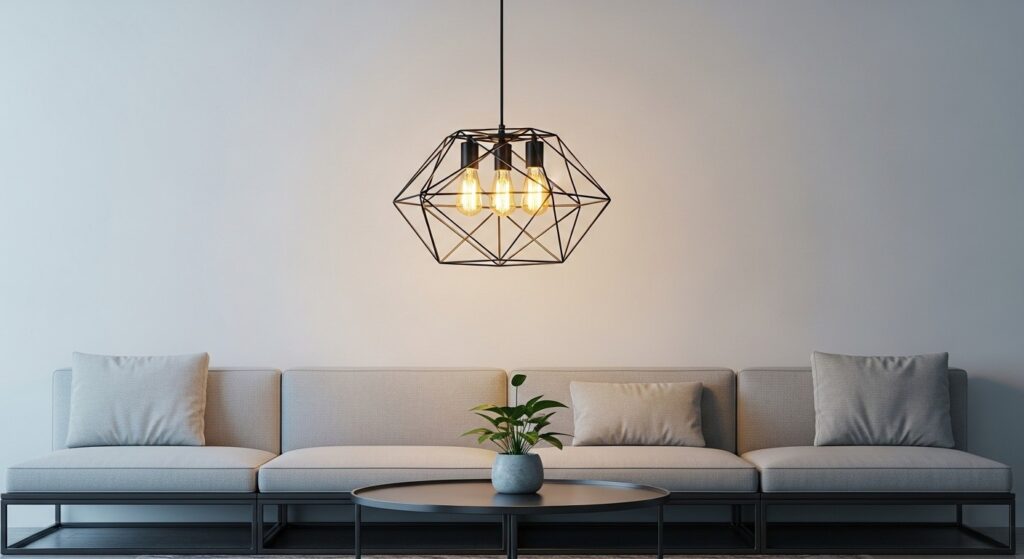
- Exposed-bulb pendants work best in rooms with 9+ foot ceilings
- Rattan or woven shades add warmth without losing the modern edge
- A warm-white LED at 2700K mimics the glow of an old-fashioned incandescent
- Dimmer switches are one of the best low-cost upgrades in any room
4. Table Lamps vs Floor Lamps
Both have a role in a well-lit living room — the trick is knowing which one your space needs more. Table lamps work brilliantly on side tables, consoles, and shelves. They pull light down to eye level and create those cosy pockets of warmth that make a sofa feel genuinely inviting. Look for bases with clean geometric shapes in ceramic, stone, or brushed metal for a contemporary feel.
Floor lamps, on the other hand, are the workhorses of small-space lighting because they take up zero surface area. An arc lamp that curves over your sofa handles both task lighting and ambiance in one footprint. Tripod styles with a linen shade read as sculptural objects even when the light is off — they look intentional, which is exactly the vibe.
When choosing modern lamps for your living room, one well-chosen statement lamp does more than three small, mismatched ones. Pick your hero piece first — probably a floor lamp — and build from there.
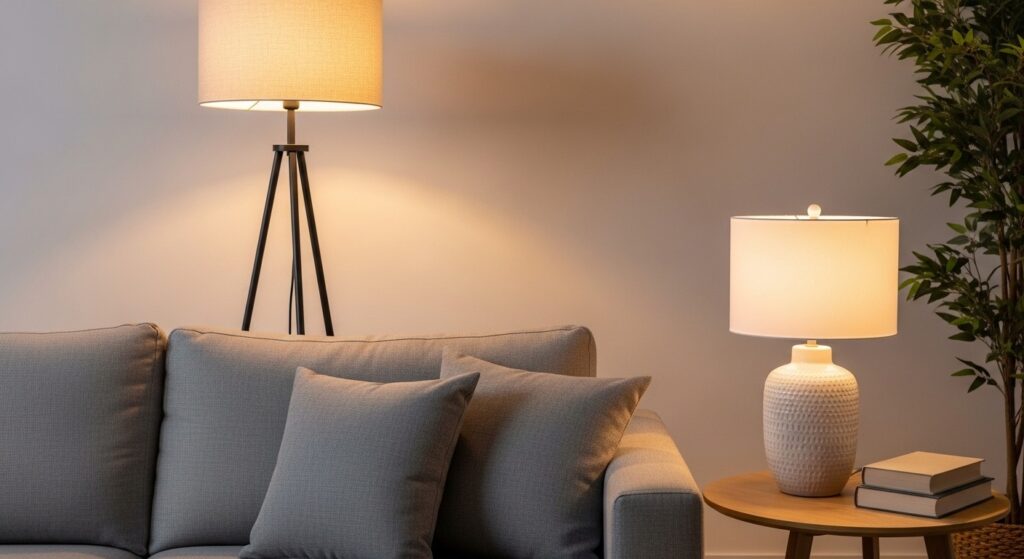
- Arc lamps hover over seating without adding extra floor footprint
- Table lamp height: the bottom of the shade should sit at seated eye level
- Use the same bulb temperature across all lamps for a cohesive, warm glow
5. Wall Sconces for Space Saving
Wall sconces are massively underused in small apartments, and that’s a shame — they’re one of the best contemporary light fixtures you can add. They free up every inch of floor and surface space while delivering layered warmth at exactly the right height. Think of them as the supporting cast that makes the whole scheme feel complete.
If you’re renting, plug-in sconces are your best friend. No electrician needed, no drilling (just a small hook for the cord), and the styles available now look genuinely custom-installed. Mount them on either side of a sofa, above a console table, or flanking a gallery wall. The effect is immediate.
For a truly modern look, a single-arm swing sconce in matte black or brushed nickel has strong architectural lines that double as decor even when the light is switched off. It earns its place whether it’s on or not.
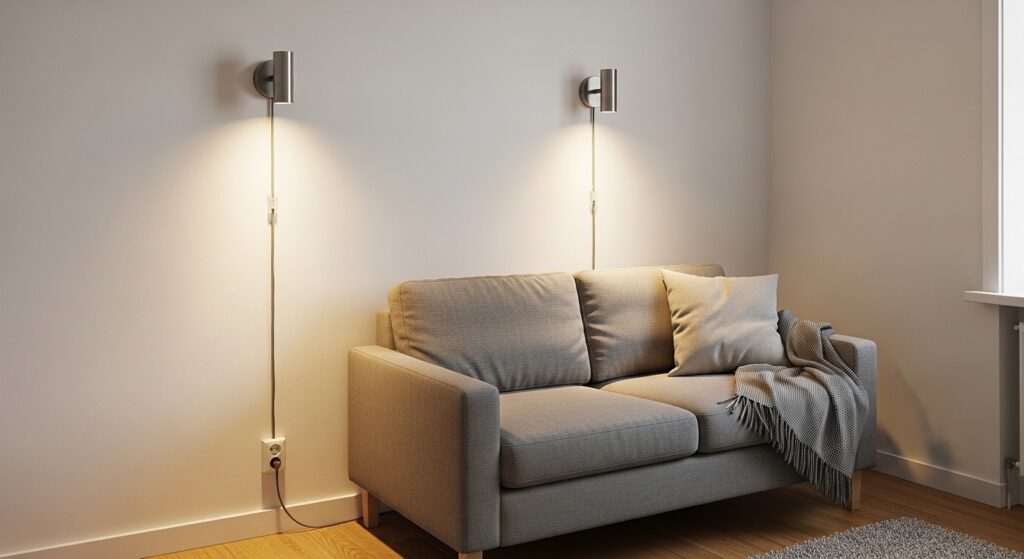
- Plug-in sconces require no electrician — perfect for renters
- Mount at 60–66 inches from the floor for the most flattering light angle
- Use cord covers or raceways to keep wiring looking clean and deliberate
- Choose dimmer-compatible sconces for the same mood control as overhead fixtures
6. Layered Lighting Basics
Here’s the secret behind every living room that looks like it belongs in a magazine: layering. The concept is simple — you combine three types of light so no single source does all the work. Ambient light handles the overall glow. Task light is functional, placed where you sit and read. Accent light is decorative, adding warmth and personality in smaller doses.
Your pendant or flush mount handles ambient. A reading lamp or arc floor lamp handles task. Accent light comes from smaller touches — a LED strip behind your TV, a backlit shelf, even a few candles on the coffee table. Not everything has to be electric. The combination is what matters.
Start with your overhead ambient light, then add a task lamp where you actually sit. Step back and look. Then layer in one accent source. You’ll notice when it’s “enough” — the room stops feeling flat and starts feeling curated. It’s a genuinely satisfying thing to watch happen.
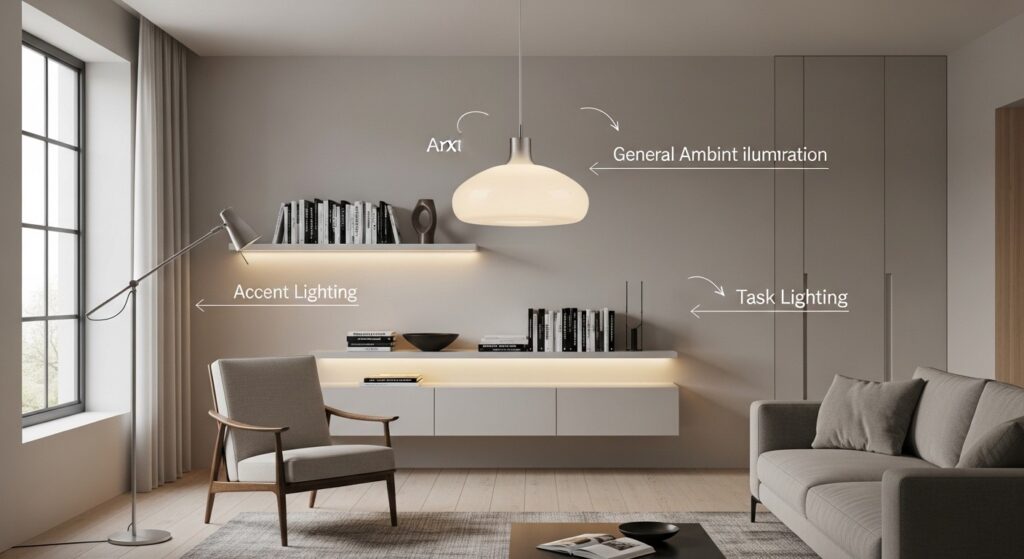
- Ambient: Overhead pendant, flush mount, or recessed ceiling lights
- Task: Arc lamp, table lamp beside seating, or an adjustable sconce
- Accent: LED strip, backlit shelf, picture lights, or candles
- Aim for 3–5 light sources total for a complete, layered feel
Common Mistakes to Avoid
Even with the best intentions, a few common missteps can undo a lot of good work. Here’s what to watch out for:
| 1 | Making It Feel Cold and SterileCool-white bulbs work great in offices — not living rooms. Swap them for warm white (2700K–3000K) and your space will feel more welcoming right away, no furniture changes required. |
| 2 | Going Too Matchy-MatchyModern design thrives on intentional mix, not a matching set. Pair a matte black pendant with a brass sconce and a ceramic table lamp — they’ll feel cohesive if they share a bulb tone and a sense of scale. |
| 3 | Choosing Cool Over ComfortableA sculptural fixture that puts out harsh light is still bad lighting. Always check the lumen output and color temperature before buying. The prettiest lamp in the world won’t matter if it gives you a headache. |
| 4 | Forgetting Personal TouchesModern doesn’t mean anonymous. A lamp with a handmade ceramic base, a vintage industrial sconce, or a pendant you found at a market all add character. Your lighting should feel like someone actually lives there. |
Frequently Asked Questions
Q What defines modern living room style?
Modern living room style is all about clean lines, intentional choices, and a curated mix of materials — think matte metals, natural wood, stone, and linen. It prioritises function without sacrificing visual interest. Unlike minimalism, which strips almost everything away, modern design allows for warmth, texture, and layering — as long as each element earns its place. In lighting terms, that means fixtures with strong architectural shapes and quality finishes, rather than anything overly ornate or decorative.
Q How do I make modern feel cosy?
Warmth in a modern space comes from texture, light temperature, and scale — and lighting is the fastest lever of the three. Swap cool-white bulbs for warm-white LEDs, bring lamp height down to eye level, and add a dimmer to your overhead light. A chunky throw, a natural fibre rug, and a warm floor lamp beside the sofa can genuinely transform the mood in under ten minutes. You’re not abandoning modern style; you’re giving it the human element it needs to feel like a real home.
Q What colours work for modern living rooms?
Modern palettes tend toward neutrals with clear contrast: warm whites, creamy off-whites, soft greige, charcoal, and black. From there, you bring in one or two accent tones — a terracotta cushion, a sage green chair, a warm brass fixture. Lighting plays directly into colour perception: warm bulbs enrich earthy tones and soften cooler shades. If your walls are a cool white, warm lighting is your correction tool — it shifts the whole room toward comfort without a single drop of paint.
Q Is modern style expensive to achieve?
It really doesn’t have to be. Modern design’s focus on restraint and intentionality actually works in your favour on a budget — because you’re buying fewer, better things rather than filling space. For lighting, start with one strong overhead fixture and one key lamp. Add sconces and accent lighting as your budget allows. A plug-in sconce, a dimmer switch, and a warm-white LED bulb can collectively run under £50 and completely change how a room feels. Thoughtful beats expensive, every time.
Bring Your Living Room to Life
Modern living room lighting isn’t about buying the most expensive fixture or following a rigid rulebook. It’s about understanding how light shapes the way a room feels — and then using that knowledge to your advantage. You don’t need to overhaul everything at once. Start small: maximise your natural light, swap your bulbs for warm-white LEDs, and plug in a floor lamp beside your sofa. Those three steps alone will visibly change your space.
From there, layer in a wall sconce, an accent light, and eventually a statement overhead fixture when you’re ready. Take it one step at a time. Every beautifully lit room started with a single good decision — and yours is just a few switches away.
KEEP READING
Ready to go further? Explore these related guides: Modern Living Room Wall Decor Ideas