
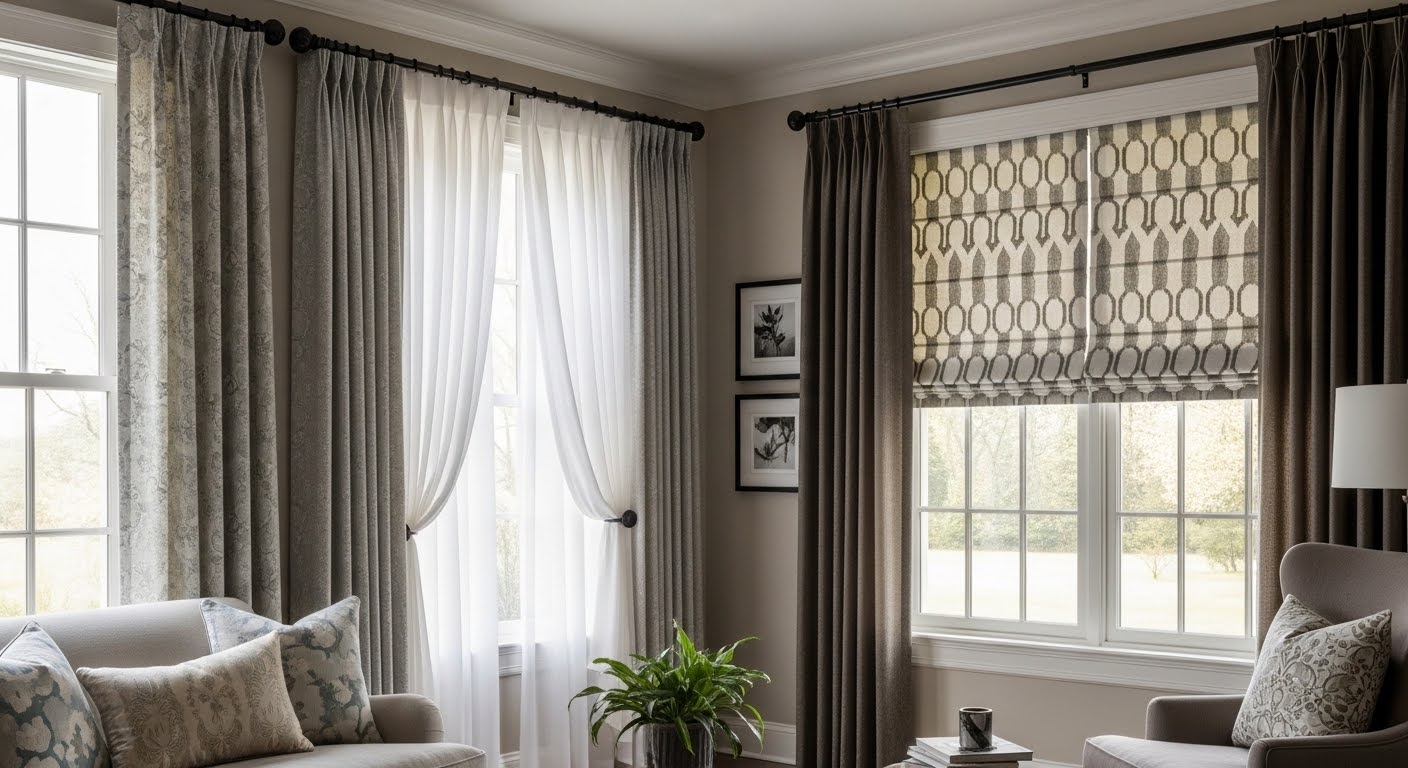
Small Living Room Curtain Ideas: Windows That Wow
You love your apartment. You really do — except for those windows. They feel a bit awkward, maybe too small, and somehow the whole living room looks a little flat because of them. Sound familiar? You’re not alone. Curtains are one of the most underestimated decorating tools out there, and getting them right can genuinely change how your room feels every single day.
The good news: you don’t need to knock down walls or hire a contractor. Smart small living room curtain ideas can make a space feel taller, wider, and a whole lot more pulled-together — without blowing your budget. This is the kind of fix that makes guests walk in and say, “Wait, how did you make this feel so big?”
In this guide, you’ll learn how to hang curtains the right way, choose fabrics and colors that actually work in compact spaces, pick the right length, and find hardware that ties everything together without overwhelming the room. Let’s turn those windows into your living room’s best feature.
Quick Summary
WHO THIS IS FOR
Apartment renters, first-time homeowners, and small-space dwellers
TIME TO READ
5 min
TOP 3 TAKAWAYS
1. The Hang High and Wide Rule
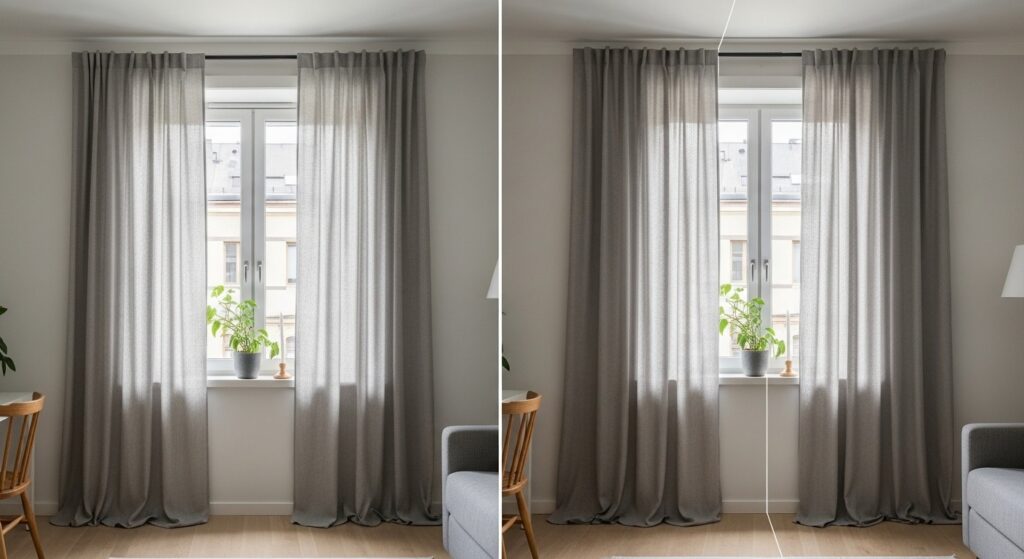
Here’s the single biggest curtain move you can make in a small room — and it costs nothing extra. Instead of mounting your rod right above the window frame, go as close to the ceiling as you can. Somewhere between four and six inches from the ceiling is the sweet spot. Your eye follows the curtain upward, and suddenly the ceiling feels much higher than it actually is. It’s almost optical illusion territory, and it works every time.
Go wide, too. Push the rod 8 to 12 inches past the window frame on each side. When the curtains are open, they stack off the glass completely, exposing the full window and letting in a lot more natural light. This is the window treatment tip for small rooms that interior designers use on almost every project.
You don’t need a new window to make this work. All you need is a longer rod and the confidence to go higher than feels instinctive. Try it once and you’ll wonder why you ever hung curtains any other way.
Quick tips:
- Mount the rod 4–6 inches from the ceiling, not the window frame
- Extend the rod 8–12 inches past each side of the window
- Use floor-length panels even if your window is on the shorter side
- Check your walls for studs or use drywall anchors rated for the weight
2. Sheer vs. Opaque Options
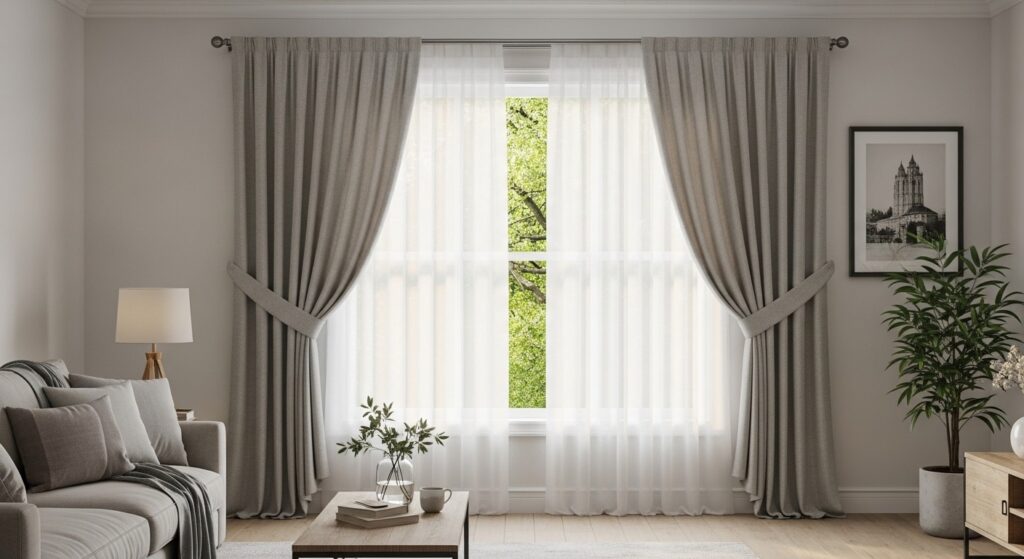
Sheers are a small space’s best friend, full stop. They filter light without blocking it, so the room stays bright and airy even when the curtains are closed. A soft linen sheer or a lightweight voile panel can instantly make a compact room feel open and calm. If your living room faces a quiet courtyard or a garden, sheers alone might be all you need.
Opaque curtains have their place too — especially if you’re dealing with a busy street view or you genuinely want privacy after dark. The trick is to layer. A sheer panel sits closest to the glass. An opaque drape hangs on the outer rod. Pull the drape closed only when you actually need to, and keep the room bright the rest of the time. It’s flexible and looks polished.
For drapes in a tiny living room, steer away from heavy materials like velvet or thick brocade. These fabrics absorb light and make small spaces feel more enclosed than they already are. Linen, cotton, and lightweight polyester blends are your best bets for keeping things fresh and light.
3. Color Selection Tips
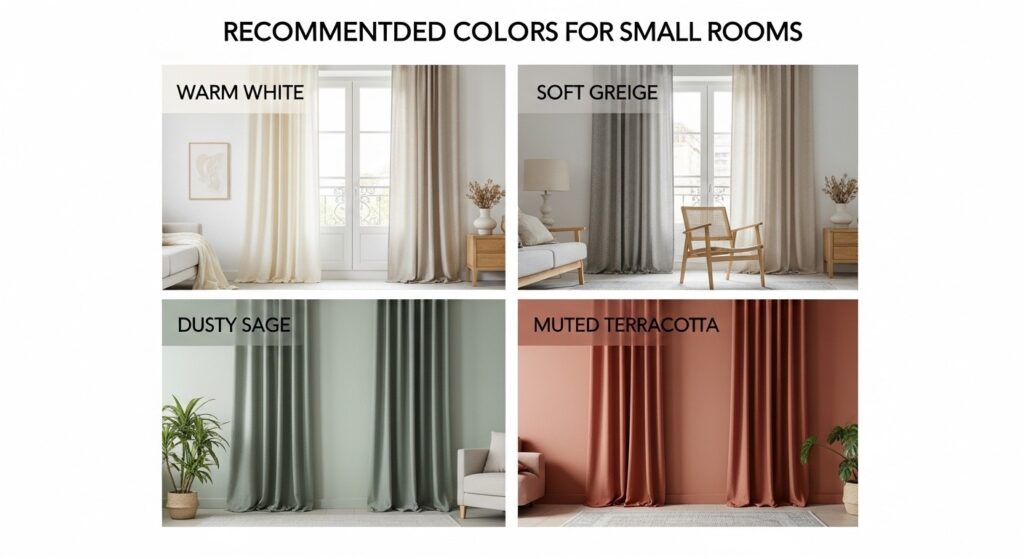
Color is where a lot of people get nervous, but it’s also where you can have the most fun. As a general rule, curtains that closely match your wall color make a room feel bigger and more cohesive. The eye doesn’t “stop” at the curtain — it just flows around the space. Designers call this a tonal look, and it’s quietly brilliant in small rooms.
That said, contrast can absolutely work — just keep it intentional. A deep navy or earthy green curtain against a light wall creates a strong, deliberate focal point. One bold moment is plenty. Too many competing colors in a small space start to feel chaotic. And if you’re drawn to patterns, keep the scale small or go with texture instead of print.
For a deeper look at palettes that work in compact spaces, check out our guide to Small Living Room Color Ideas. Getting the wall and curtain color right is often more impactful than any furniture change.
Color tips at a glance:
- Match curtain color to wall color for a seamless, spacious look
- Light neutrals — white, cream, greige — keep things bright and open
- One bold accent color works well; two competing bold colors do not
- Choose texture or subtle pattern over large-scale prints
4. Length: Floor or Sill?
Floor-length curtains almost always win in a small living room. They draw the eye down along a long vertical line, making the ceiling feel higher and the room feel grander. Even if your actual window is only halfway up the wall, panels that hang from near the ceiling all the way to the floor create the impression of a tall, full window. It’s one of the oldest tricks in the book, and it keeps working because it genuinely fools the eye.
Sill-length curtains have their place — above a radiator, for instance, or in a kitchen-adjacent nook. But in a living room, they tend to cut the space visually in half. They highlight where the window ends rather than letting the eye travel freely. When in doubt, always go floor-length.
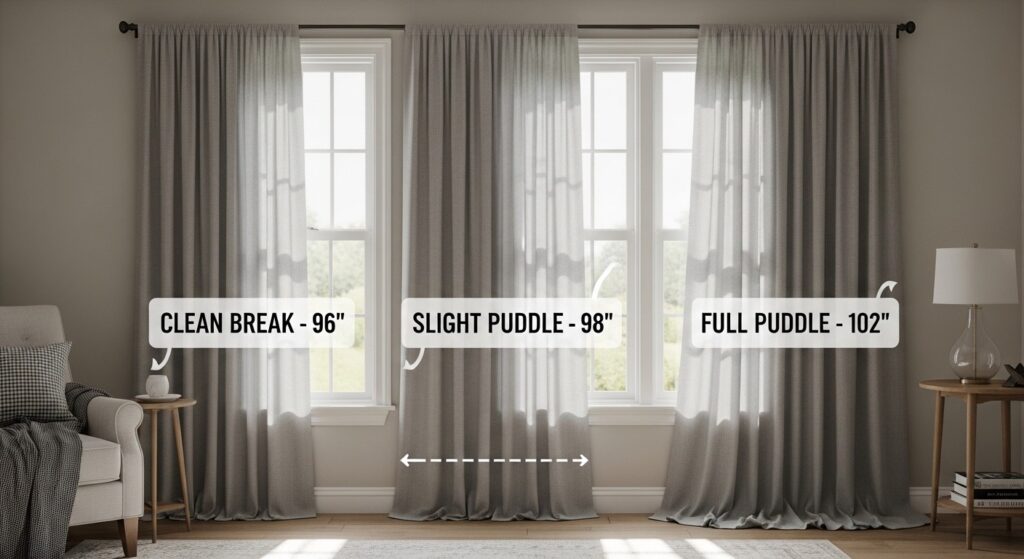
For the hem itself, you have three options. A clean break just grazes the floor. A slight puddle lets about an inch of fabric rest on the floor. A proper puddle pools three to five inches. All three look intentional and stylish. What doesn’t look intentional is a curtain that hovers two inches above the floor, leaving an awkward gap that catches the eye for all the wrong reasons.
5. Blinds vs. Curtains
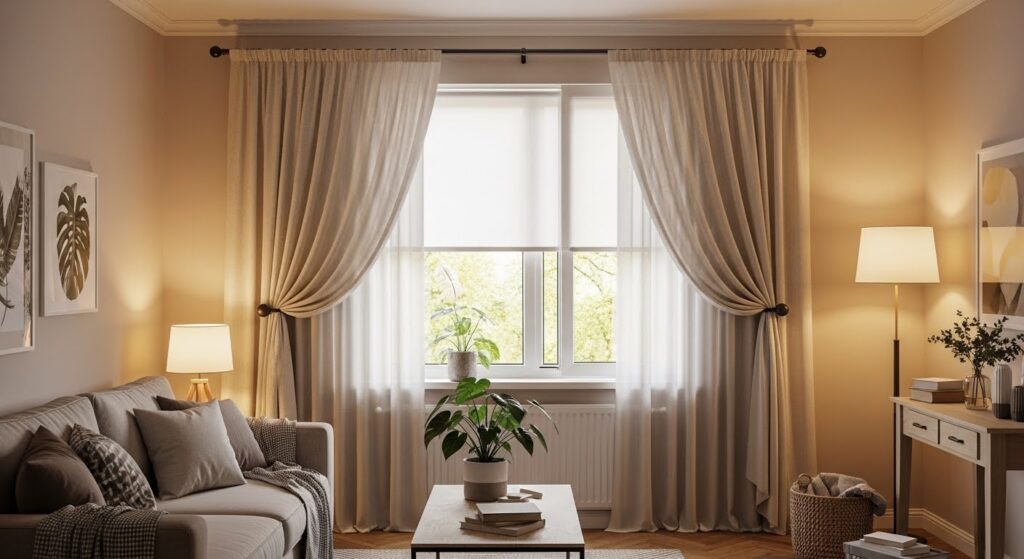
The good news here is that you don’t have to pick a side. Blinds and curtains can work together in a small living room, and honestly the combination is often better than either one alone. Blinds give you precise light control and a clean look when they’re raised. Roman shades work especially well in small spaces because they disappear completely when pulled up, leaving the window totally unobstructed. Roller blinds are the most streamlined if you want the window to practically vanish during the day.
Curtains bring softness, warmth, and texture that blinds just can’t match. A room with only blinds can feel a bit cold or office-like. Adding curtain panels — even purely decorative ones that never close — frames the window and gives the room a more finished, intentional feel.
For the best of both worlds, try pairing a roller blind or cellular shade fitted inside the window frame with floor-length curtain panels on a rod mounted high and wide. You get the practicality of the blind and the visual impact of the curtain. It’s the layered approach that most designers use in small apartments, and it’s hard to beat.
Good to know:
- Roller blind inside the frame + curtain panels outside = best of both worlds
- Roman shades save wall space and look elevated in small rooms
- Skip bulky cornice boxes — they eat ceiling height you can’t afford to lose
- Cellular shades add insulation, useful for drafty apartment windows
6. Hardware That Fits
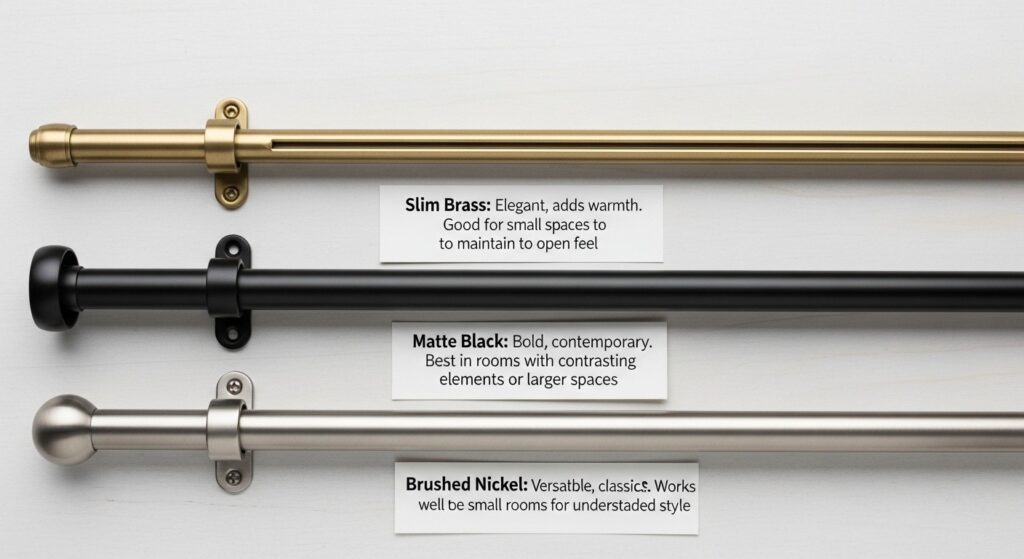
Curtain hardware is easy to overlook, but the wrong rod can undo everything you’ve worked hard to create. In a small room, slim rods — around three-quarters of an inch to one inch in diameter — look far more proportional than chunky ones. A thick wrought-iron rod might look stunning in a high-ceilinged Victorian sitting room. In a compact apartment, it just reads as heavy and a little out of place.
The same goes for finials, the decorative ends that cap the rod. Keep them simple. Ball finials or clean square ends work well in small spaces. Large or ornate finials push into the room visually and add clutter you don’t need. When you’re choosing between two options, pick the more streamlined one.
Also, match your hardware finish to the other metals already in the room. If your light fixtures and cabinet pulls are matte black, go with a matte black rod. Brushed gold light fittings? Brushed gold rod. This one small detail creates a cohesive, intentional look — the kind that makes a room feel properly designed rather than assembled over time. For ideas on pulling together lighting and hardware, check out our post on Small Living Room Lighting Ideas.
Common Mistakes to Avoid
Even the best curtain choices can fall flat if a few classic small-room pitfalls are lurking in the background. Here’s what to watch out for:
- Pushing all furniture against the walls. It feels logical but actually makes a small room look smaller. Pull seating slightly away from the walls to create breathing room and define the space.
- Using oversized furniture. A sofa that’s too deep or a coffee table that’s too wide blocks sightlines and makes everything feel cramped. Scale matters more in small spaces than anywhere else.
- Ignoring vertical space. Tall shelves, high-mounted artwork, and ceiling-height curtains all direct the eye upward. Use your walls from floor to ceiling and the room opens up considerably.
- Too many small decor items. Lots of little objects create visual noise. In a small room, fewer but larger statement pieces always look more intentional — and more spacious.
- Poor lighting choices. A single overhead bulb flattens the whole room. Layered lighting — floor lamps, table lamps, maybe a sconce or two — creates depth and makes the space feel more alive. See our full guide to Small Living Room Lighting Ideas for the complete breakdown.
Frequently Asked Questions
What is the best sofa for a small living room?
The best sofa for a small living room is one scaled to fit the space — not just one that technically squeezes in. Look for a sofa with a lower back, so it doesn’t block light or sightlines, and one with legs raised off the floor. Seeing the floor beneath the sofa makes the room feel more open. A two-seater or apartment-sized sofa with a seat depth of around 32 to 34 inches tends to hit the sweet spot.
Avoid sectionals unless your room is specifically shaped for one. They tend to dominate small spaces in a way that’s hard to work around. A light-colored sofa in a neutral fabric is also a safe choice — it keeps things feeling airy rather than heavy.
If you want more seating, add a couple of accent chairs you can move around. That kind of flexibility matters more in a small room than a large, fixed piece of furniture. You’ll find more layout ideas in our guide to 50 Small Living Room Ideas.
How do I make my small living room look bigger?
Start with the basics: hang curtains high and wide (covered in detail above), use mirrors to bounce light and create depth, and keep as much floor visible as possible by choosing furniture with legs. Each of these tricks works on how the brain perceives space rather than changing any actual square footage.
Light is your most powerful tool. A well-lit room always feels bigger than a dim one. Mix overhead lighting with accent lamps to eliminate dark corners. Light-colored walls and ceilings reflect light and visually push the walls back.
Clutter is the enemy. Storage solutions that hide visual noise — closed cabinets, baskets, organized floating shelves — instantly open up a room. A small space with great bones and minimal clutter will always feel bigger than a larger room that’s overfull.
What colors make a small room look larger?
Light, neutral colors are consistently the most effective at making small rooms feel larger, because they reflect more light. Soft whites, warm creams, pale greiges, and light grays are the classic choices. Painting the walls, trim, and ceiling in the same color or very similar tones creates a seamless envelope that tricks the eye into reading the room as bigger.
Dark colors don’t automatically shrink a room, though. A space painted in deep navy or charcoal, with excellent lighting and pared-back furniture, can feel rich and deliberate rather than cramped. The key is compensating with more light.
Soft sage green, dusty blue, and warm blush are also great choices for small living rooms. They read as light and airy while still adding real personality. For a full color walkthrough, visit our guide to Small Living Room Color Ideas.
Should I use a rug in a small living room?
Yes — but size it correctly, because the wrong rug is worse than no rug at all. The most common mistake is going too small. A tiny rug floating in the middle of a room makes the space feel disconnected and even more compact. Aim for a rug large enough for at least the front legs of your sofa and chairs to sit on.
In a small living room, an 8-by-10-foot rug is usually the minimum to consider. If budget is tight, a larger rug in a simple style almost always looks better than a smaller rug with an elaborate pattern. And if the room is very small, a solid-color or low-pile option will ground the space without adding visual noise.
Light-colored rugs with low pile keep rooms feeling open. Darker rugs with heavy patterns can work in the right context, but they do anchor the floor in a way that can feel heavy in a very small space. When you’re unsure: go light, go large, go simple.
Ready to Transform Your Windows?
Small living room curtain ideas don’t need to feel complicated. Start with just one change: hang your rod higher and wider than feels natural. That single move shifts everything. From there, you can layer in the right fabric, nail the color, and choose hardware that ties the whole room together. None of this has to happen all at once.
Your windows aren’t a limitation — they’re an opportunity. With the right window treatments for a small room, they become one of the most beautiful things about your space. You’ve absolutely got this.