Rental Living Room Ideas: Decorate Without Damage
So you’ve moved into your rental and you’re staring at those beige walls again. You want to make the place feel like home — something warm, personal, a little stylish — but there’s that clause in your lease about nails, drilling, and painting. It stops a lot of renters before they even start.
But here’s something most decorating guides gloss over: you don’t need to touch a single wall to create a living room you genuinely love. Some of the most inviting apartments I’ve seen belong to renters who worked entirely within the rules. No damage, no drama — just smart, intentional choices that transformed a forgettable space into something really special.
In this guide, I’m walking you through everything. From picking a focal point to knowing what to get rid of, these rental living room ideas are practical, deposit-safe, and completely doable — whether you’re decorating on a shoestring or ready to invest a little more. Let’s get into it.
Quick Summary
WHO THIS IS FOR
Renters who can’t make permanent changes, apartment dwellers, small-space decorators
TIME TO READ
6 min
TOP 3 TAKAWAYS
1. The Less-Is-More Philosophy
I know it sounds counterintuitive. You want your space to feel fuller, more styled — so why would you add less? But walk into any rental that feels genuinely warm and pulled-together, and you’ll notice the same thing: there’s room to breathe. Surfaces aren’t crowded. Corners aren’t stuffed. Things have space around them.
A good rule of thumb? Think in thirds. One third of your surfaces stay clear. One third holds everyday functional items. One third gets your decorative pieces. That’s it. It keeps things from tipping into clutter, even when you’re working with a small space.
There’s a practical upside too. Fewer things means less to pack when you eventually move, less to accidentally damage, and less to keep track of. You’re not sacrificing style — you’re just being deliberate about it.
- Only keep what genuinely earns its spot — beauty or function, ideally both
- Odd numbers (three, five) look more natural on shelves and trays than even groupings
- Negative space isn’t emptiness — it’s breathing room, and it reads as intentional
2. Choosing a Focal Point
Here’s a trick interior designers use all the time: give the eye somewhere to land. Every well-composed room has one thing that anchors the space — a spot that pulls your attention and organizes everything else around it. In a rental, this is even more useful because it redirects the eye away from the things you can’t change.
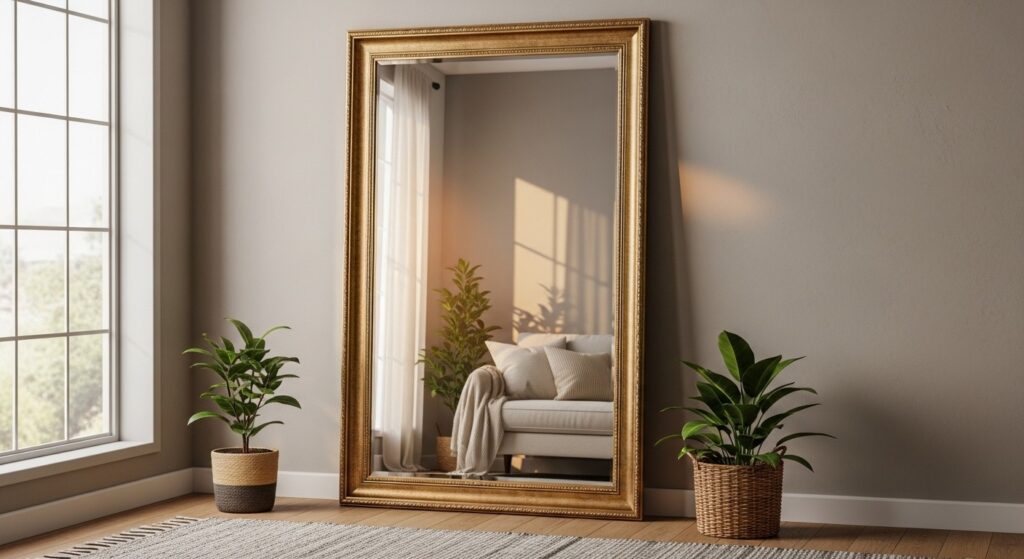
You have more options than you might think. A large mirror leaning against the wall adds depth and light without any hardware. A gallery arrangement built with removable adhesive strips can look just as polished as one that’s drilled in. A big, beautiful rug or a styled bookshelf can absolutely serve as the room’s anchor too.
The key is to commit to one focal point and then build the room outward from it. Your sofa faces it. Your lighting draws attention to it. Your accessories quietly support it. When everything points to the same place, the room stops feeling random and starts feeling designed.
- A leaning mirror: instant light, depth, and visual interest — no drilling needed
- A large rug: anchors the seating area and sets the whole room’s tone
- An oversized framed print or artwork propped against a shelf or wall
- A well-styled bookshelf: functional and decorative at the same time
3. Scale and Proportion Basics
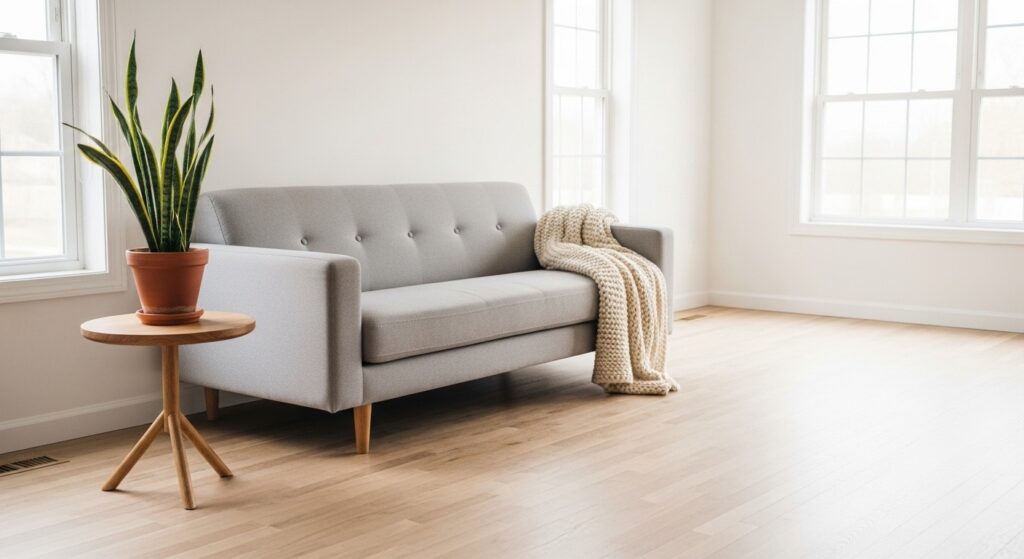
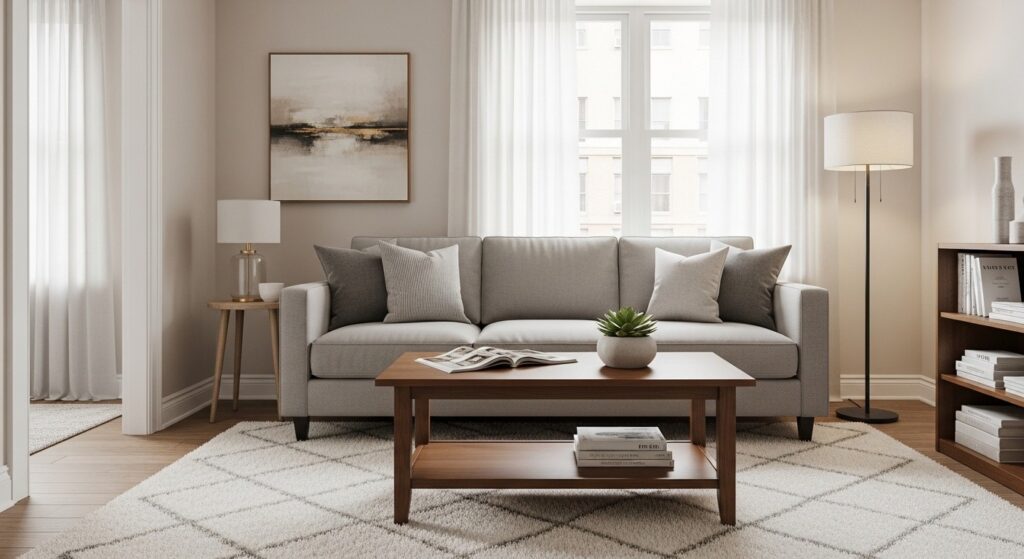
This is one of those things that’s hard to articulate but instantly noticeable when it’s wrong. A sofa that’s too small for the room looks like it’s floating. A sectional that’s too big leaves no room to move. Furniture that’s the wrong height relative to your coffee table or rug just feels… off. Scale matters more than style, honestly.
The fix is simple and free: measure everything before you commit to a layout or a purchase. Measure the room. Measure your existing pieces. Measure doorways if you’re bringing in anything new. A tape measure is the most powerful decorating tool you own, and most people skip this step entirely.
A few guidelines worth keeping in mind: your rug should be large enough for at least the front legs of all your seating to rest on it. Your sofa’s length ideally shouldn’t stretch beyond two-thirds of the wall behind it. And leave at least 18 inches of walkway space on each open side of the sofa so the room feels navigable.
- Rug size: almost always go one size larger than your instinct says
- Coffee table height: cushion level or just slightly below looks most balanced
- Table lamp height: the shade should sit at roughly eye level when you’re seated
- Sofa proportion: it should fill the space comfortably without dominating it
4. Mixing Textures Effectively
If you can’t paint your walls or change your floors, texture is your best friend. It’s what makes a simple, neutral room feel layered and warm rather than flat and boring. And because texture lives entirely in your soft furnishings and accessories, it’s 100% renter-friendly.
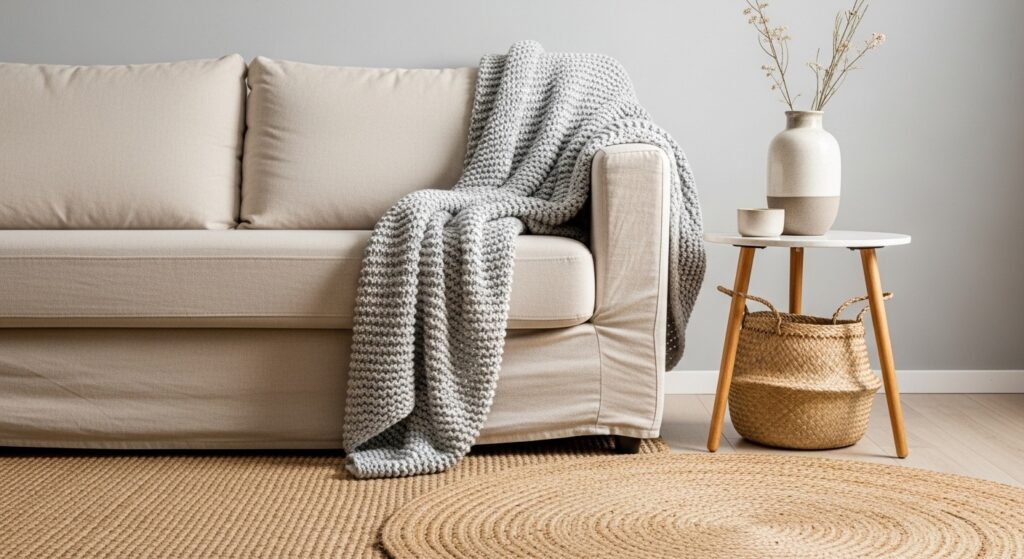
Think about contrast as you layer things in. Smooth against rough. Soft against firm. Matte against a hint of shine. A linen sofa already gives you a soft, woven texture — pair it with a chunky knit throw, a jute rug underfoot, and a ceramic vase on the side table, and you’ve got four different textures working together in the same corner. That’s what makes it feel rich.
You really don’t need a formula here. Just look at what’s already in the room and ask yourself: does everything feel like the same surface? If yes, bring something in with a different quality. That one shift makes a bigger difference than most people expect.
- Soft: linen, velvet, cotton throws, woven cushion covers, curtains
- Natural: jute, rattan, wicker, wood, unglazed ceramics, dried botanicals
- Hard and smooth: glass, polished metal, lacquered trays, glazed ceramics
- Aim for at least four distinct textures in any main seating area
5. Color Coordination Tips
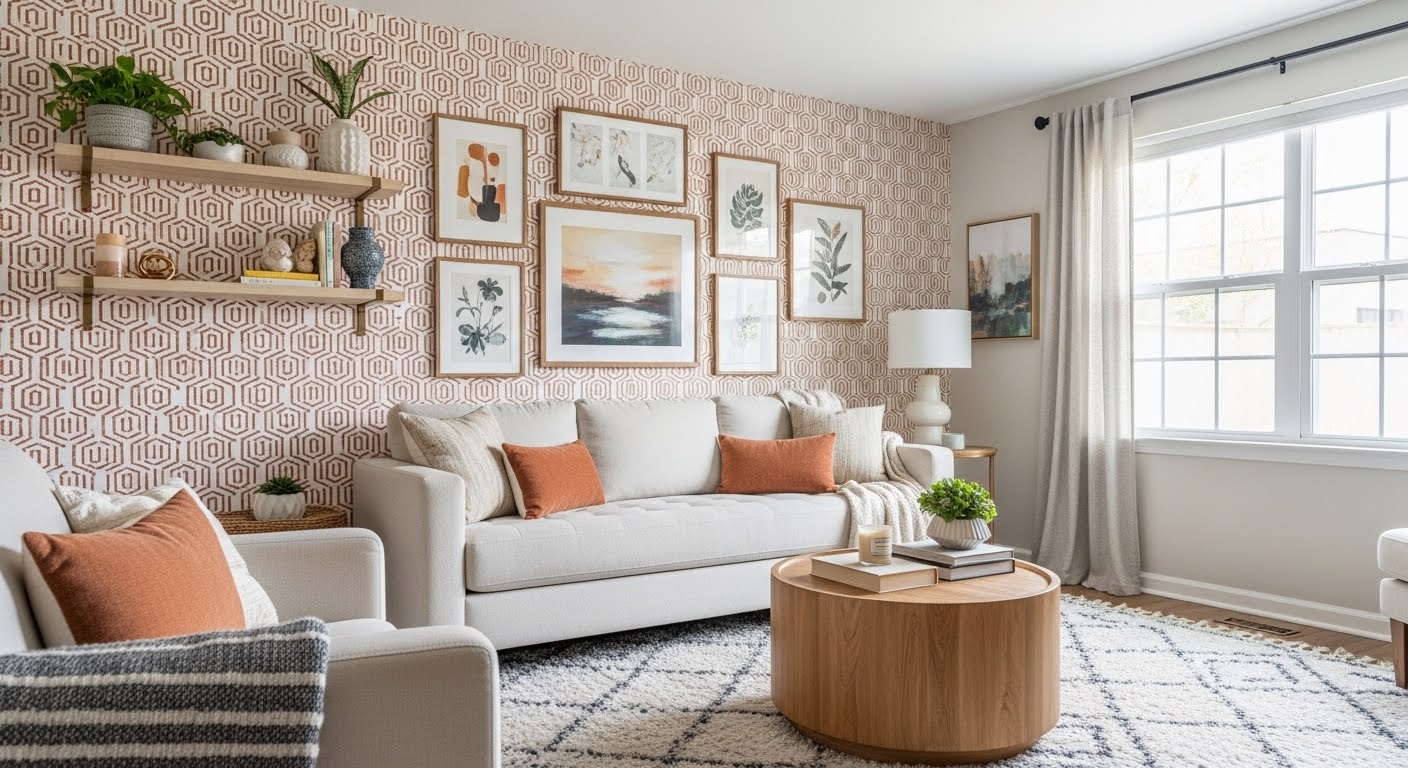
No paint? No problem. Color doesn’t live on walls — it lives in rugs, pillows, curtains, art, and plants. All of those things are easy to bring in, easy to move, and easy to swap out when you’re ready for a change. That makes color one of the most flexible tools in a renter’s decorating toolkit.
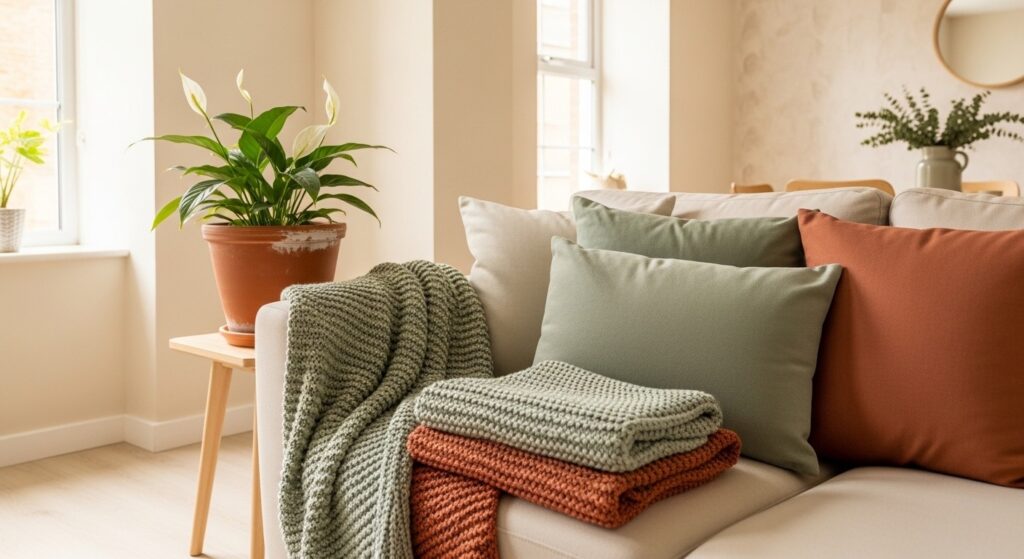
If you’re not sure where to start, try the 60-30-10 rule: about 60% of the room in neutrals, 30% in a secondary color you love, and 10% in a pop accent. So maybe your sofa and rug are warm cream and tan (the 60%), your throw pillows and curtains bring in a dusty sage (the 30%), and a single terracotta pot or rust-colored tray adds that finishing note (the 10%). Simple, cohesive, and very livable.
For renters especially, earth tones are your friend. Terracotta, warm sage, clay, caramel — these shades work beautifully against almost any existing rental palette and they’re warm enough to make a space feel homey without being bold to the point of overwhelming.
- Repeat a color in at least three spots to create visual rhythm — it ties the room together
- Warm whites read cozier than cool whites, especially in small or low-light rooms
- Keep accent colors to three maximum, or things start to feel chaotic
- Earth tones age well — they stay current without being trendy
6. Personal Touches That Work
At some point, every home decor guide tells you to ‘add personal touches.’ It sounds simple, but in practice it’s where a lot of people go wrong — either by being too cautious (the room stays sterile) or going too far (it looks like a flea market). The sweet spot is a room that feels genuinely like you while still looking considered.
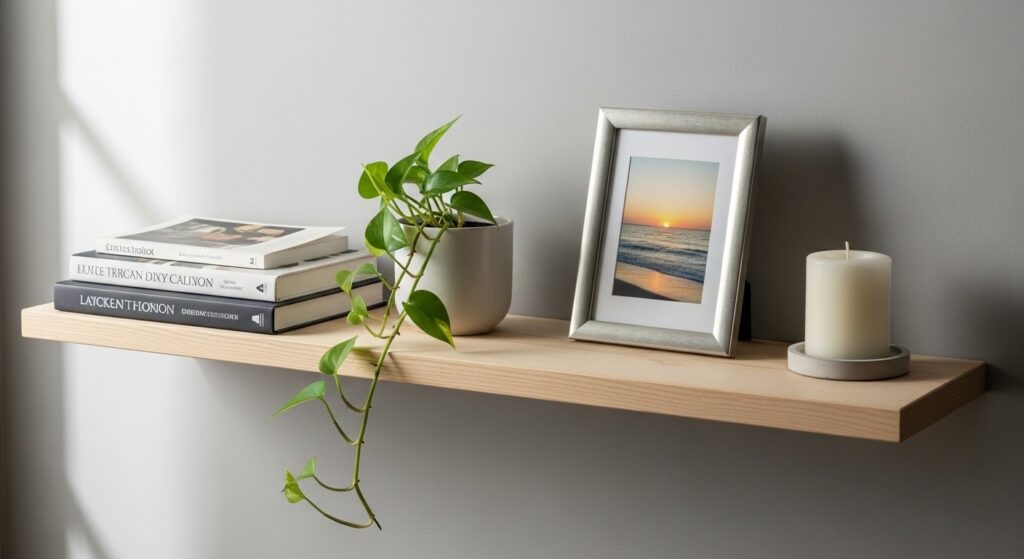
A few objects that tell your story, placed thoughtfully, work better than a whole collection scattered everywhere. A stack of your actual favorite books on the coffee table. One framed photo propped on a shelf next to a plant. A candle in a scent you love. These are small things, but they’re the details that make a visitor feel like they’ve walked into someone’s home rather than a showroom.
And practically speaking: every one of those things fits in a box when it’s time to move. Personal doesn’t have to mean permanent, and in a rental that’s exactly the point.
- Plants: alive, movable, and they make any room feel more welcoming
- Books styled by color or stacked as a surface: adds character without clutter
- Framed photos or prints propped on shelves or ledges — no hooks or nails needed
- A candle or a small diffuser adds a sensory layer that photos can’t capture
7. What to Edit Out
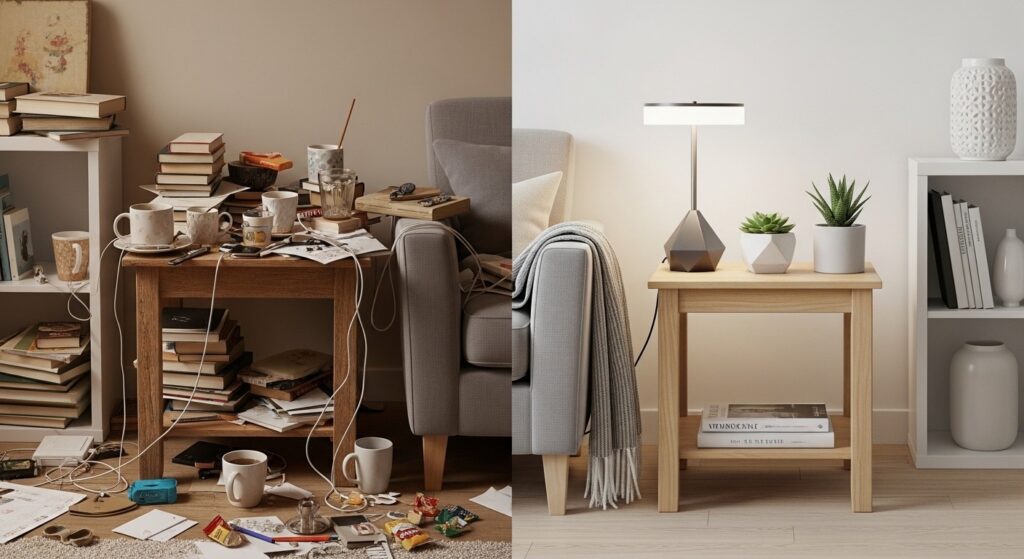
Here’s the truth: a lot of living rooms don’t need more stuff. They need less. Editing — actually removing things — is one of the highest-impact decorating moves you can make, and it costs absolutely nothing. But it’s surprisingly hard because we get attached to things, or we feel like an empty surface means we haven’t ‘finished’ the room.
Try this: walk through your living room with fresh eyes, like you’re seeing it for the first time. For every object, ask three questions. Does this serve a real purpose here? Do I genuinely like looking at it? Does it belong in this room? If the answer to all three is no, it’s taking up visual space without giving anything back. It can go.
Some of the most common culprits: tangled cords left out on surfaces, too many throw pillows stacked on the sofa, items that drifted in from other rooms and never left, and things you bought on a whim that never quite fit. Removing even two or three of those things tends to make the whole room feel cleaner and more intentional overnight.
- Cords and chargers: tuck them into a small basket or clip them along a baseboard
- Throw pillows: three to five on a standard sofa is plenty — odd numbers look natural
- Migrant clutter: anything that ‘lives’ in your living room by default but belongs elsewhere
- Things you don’t love: keeping them doesn’t honour them — it just fills space
Common Mistakes to Avoid
Knowing what not to do is just as useful as knowing what to do. These are the four mistakes that come up most often with renters who are decorating for the first time — or the fifth.
- It’s the single most expensive decorating mistake. Before buying anything — furniture, rug, even curtains — measure the room, the walls, the doorways. A sofa that doesn’t fit through the front door or a rug that’s dwarfed by the seating area are completely avoidable problems. Not measuring first.
- You can’t change your floors, baseboards, or window trim — so work with them instead of against them. Warm wood floors love warm neutrals. Cool grey tiles open up beautifully with lighter, airier palettes. Fighting your fixed elements creates tension that no amount of decorating can smooth over. Decorating against your existing elements.
- A trend that looks perfect on someone else’s feed might feel completely wrong in your space. Timeless pieces you genuinely love will serve you far better than whatever finish or colour is popular right now. Buy things you’re happy to own for years, not seasons. Chasing trends instead of building personal style.
- Jumping straight to shopping — even with good taste — leads to a room full of pieces that don’t quite work together. Spend 30 minutes on a simple plan first: decide your colour palette, identify your focal point, sketch a rough layout. That half-hour saves you hours of rearranging and money on returns. Skipping the planning phase.
FAQ
| Q1: What’s the most important element to focus on first?Honestly? Start with the rug. It’s the single piece that does the most work in a rental living room — it anchors the seating area, introduces colour and texture, softens hard floors, and instantly makes the space feel more considered. Most people buy a rug that’s too small, so go one size up from whatever feels right. Get the rug sorted first and everything else you add will have a foundation to work from. |
| Q2: How do I actually get started without feeling overwhelmed?Take photos first. Walk around your living room and photograph it from every angle, including the doorway. Then look at those pictures on your phone — not in person. Somehow seeing a space on a screen makes the problems much clearer. Pick the one thing that bothers you most and start there. Just one thing. That first intentional change almost always sparks the next one naturally, and the room evolves without you having to tackle everything at once. |
| Q3: What’s a realistic budget for decorating a rental living room?It really depends on where you’re starting from. If you already have furniture, a meaningful refresh — a rug, new throw pillows, a plant or two, some simple accessories — can happen for a few hundred dollars or less. If you’re building from scratch, prioritise the rug and lighting first, then layer in accessories gradually rather than buying everything at once. Taking it slow also gives you time to find pieces you genuinely love instead of just filling gaps. Check out our guide to Budget Living Room Ideas for more specific ideas. |
| Q4: How long does this kind of project realistically take?A basic refresh — rearranging, editing out clutter, adding a few new textiles — can genuinely happen in an afternoon. A fuller transformation where you’re sourcing new furniture usually plays out over a few weeks, especially if you’re being thoughtful rather than buying everything at once. The planning stage (colour palette, focal point, rough layout) only takes about an hour. Do that first and everything else moves faster. The renters who have the hardest time are the ones who skip straight to shopping. |
Final Thoughts
Renting doesn’t mean settling. It doesn’t mean you have to live in someone else’s idea of a neutral, inoffensive space for the next year or two. You can build a living room that feels warm, intentional, and genuinely yours — without touching the walls, spending a fortune, or worrying about your deposit.
Start with one thing. Make it good. Then move to the next. That’s really all this is. The best renter-friendly living rooms aren’t the result of a single big shopping trip — they’re built slowly, one thoughtful choice at a time. You’ve already got more to work with than you think.
| Want to keep going?Explore our guides to Ikea Living Room Ideas, Budget Living Room Ideas, and Wall Decor Ideas for more renter-friendly inspiration. |